
Percent Worksheet Generator
Make percent worksheets to print, every answer exact. Exercise offers five pages: Percent of a Number, such as 25% of 80; Find the Percent, such as 20 is what percent of 80; Find the Whole, such as 20 is 25% of what number; Percents and Decimals, from 35% to 0.35 and back; and Shaded Grids, hundred grids with a shaded part to turn into a percent.
Level follows the order percents are taught in: the benchmarks 10, 20, 25, 50, 75 and 100% on Easy; the other multiples of 5 on Medium; any percent on Hard, including 37%, 125% or 250%, with answers that may carry one decimal. Line numbers labels the lines from 1. to 20.; Show the instructions sets the rule of the exercise above the problems, such as part ÷ whole × 100 = percent; and Font draws the digits in Pebble or Granite.
Every page holds twenty lines in two columns, or six grids, never the same problem twice, and Show the solution fills each answer line in orange.
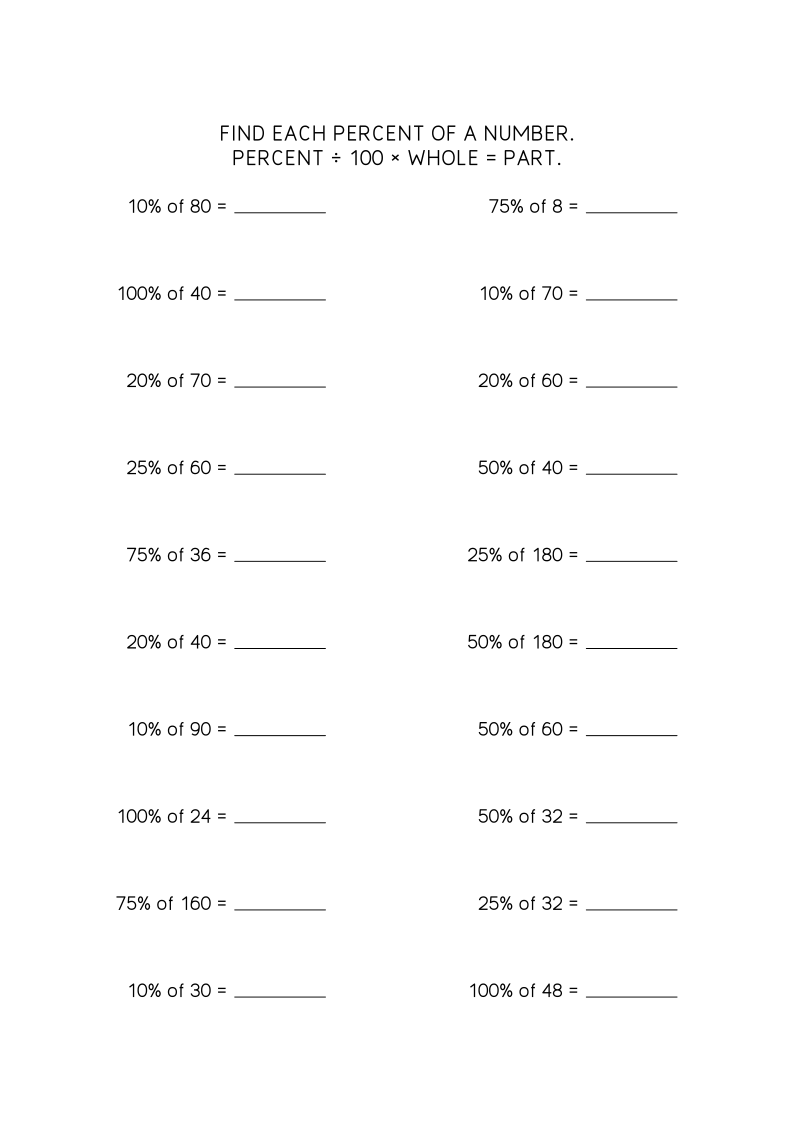
This browser is too old to make the page: please update it, or use another one. Here is an example page in the meantime.
The latest printable pages whose sheets were made with this generator, ready to download.


Frequently Asked Questions
What Does Percent Mean?
Per cent comes from the Latin per centum, for each hundred: 1% is one hundredth, 0.01, and 100% is the whole. That is why the Shaded Grids pages use a square of ten rows of ten, where each square is 1% and each full row or column is 10%. The benchmark percents match simple fractions worth knowing by heart: 50% is a half, 25% a quarter, 75% three quarters, 20% a fifth and 10% a tenth. Easy pages use only these five and 100%, so a child can reason with halves and quarters before using a rule.
How Do You Find a Percent of a Number?
Divide the percent by 100 and multiply by the number, which is the rule the instructions print: percent ÷ 100 × whole = part, so 35% of 60 is 0.35 × 60 = 21. Mental shortcuts often go faster: 10% divides by 10, 5% is half of that, 20% doubles it, 25% halves twice, and 75% is three times 25%; 35% of 60 is then 30% + 5%, 18 + 3. On Percent of a Number pages each line reads like 25% of 80 = ____, and on Hard pages the part may need one decimal, as 12% of 30 = 3.6.
How Do You Find What Percent One Number Is of Another?
Divide the part by the whole and multiply by 100: part ÷ whole × 100 = percent. For 20 is ____% of 80, the part is 20 and the whole 80, so 20 ÷ 80 = 0.25, which is 25%. Simplifying the fraction first often helps: 20 out of 80 is 1 out of 4, a quarter. The percent sign is already printed after the answer line, so only the number is written. On Hard pages the answer can be an awkward percent such as 37% or 83%, or one above 100.
How Do You Find the Whole From a Part and a Percent?
This is the reverse percentage, the step most children find hardest. If 20 is 25% of a number, then 1% of it is 20 ÷ 25 = 0.8, and 100% is 0.8 × 100 = 80; in one line, part ÷ percent × 100 = whole, as the instructions put it. A simple check: 25% of 80 must give back 20. Find the Whole pages read 20 is 25% of ____, and because the generator keeps only problems whose numbers work out exactly, the whole is always a whole number and the given part has at most one decimal.
What Numbers Does Each Level Use?
Easy pairs the benchmark percents with wholes from 4 to 200 picked so that every part is a whole number, such as 75% of 48. Medium uses 5, 15, 30, 35, 40, 45, 55, 60, 65, 70, 80, 85, 90 and 95% with multiples of 20 up to 400, so 15% of 140 = 21. Hard takes every percent below 100 that is not a multiple of 5, plus seven above 100, with wholes from 10 to 500, and allows one decimal in the part. On the Percents and Decimals pages the levels go from whole percents to halves and percents over 100, then to tenths of a percent.
Can a Percent Be More Than 100?
Yes: more than 100% means more than the whole. 150% of 40 is 60, one whole 40 and half of another, and 250% is two and a half times the number. Prices after an increase, growth over a year and scores above a target all use them. Hard pages mix 110, 120, 125, 150, 175, 200 and 250% into the three kinds of problems, and Medium pages of Percents and Decimals convert whole percents from 101% to 300%, where 250% becomes 2.5.
How Do You Change a Percent Into a Decimal?
Divide by 100, which moves the decimal point two places to the left: 35% is 0.35, 7% is 0.07, 250% is 2.5, 12.5% is 0.125 and 0.2% is 0.002. Going back, multiply by 100. On Percents and Decimals pages ten lines go each way, such as 35% = ____ and 0.35 = ____%. Easy uses whole percents from 1 to 99; Medium adds percents from 101 to 300 and halves from 0.5% to 99.5%; Hard uses tenths of a percent up to 199.9%, such as 37.4% or 112.3%. Answers are written without final zeros, 2.5 rather than 2.50.
How Do You Read a Shaded Hundred Grid?
Count the shaded squares: out of 100, their number is the percent. Easy grids shade whole rows or columns from one side, 10% to 90%, so counting by tens is enough. Medium grids add some squares in the next row or column, any number that is not a multiple of 10, so the child counts tens, then ones. Hard grids shade three separate rectangles of 2 to 6 squares a side, placed at random and never touching, even at a corner: the child multiplies the sides of each block and adds the three areas. The shading is drawn as fine diagonal hatching, which prints clearly in black and white, and the six grids of a page all show different totals.
Why Does a Page Not Keep Repeating 50%?
Because some percents fit many more numbers than others: 50% and 100% work with almost every whole, 75% with far fewer. Left to chance, they would fill the page. So the generator spreads its twenty problems across the percents of the level: on Easy each benchmark appears three or four times, on Medium each percent once or twice, and on Hard twenty different percents come up. The twenty lines are always twenty different problems.
How Are the Problems and Grids Arranged?
The four exercises in lines hold twenty problems in two columns of ten, read downward, with the answer lines of a column aligned, which makes marking easy. Line numbers prints 1. to 20. in front of them; Shaded Grids keeps its six numbered frames instead, so the setting is hidden there. The instructions sit on top: the rule of the exercise, or for grids the reminder that each grid has 100 squares. With Show the solution, every answer appears on its line in orange dashes, and the address of the page brings back the same numbers whenever it is opened.
When Do Students Learn Percents?
In the US Common Core, sixth graders learn to find a percent of a quantity as a rate per 100 and to work back to the whole when a part and its percent are known, which are the first and third exercises here; seventh graders use percents in multistep problems such as discounts, tax and percent increase. In England, Year 5 learns that per cent means parts per hundred and writes percents as fractions and decimals, and Year 6 calculates percentages of amounts, such as 15% of 360, and uses them to compare.