Multiplication Worksheet Generator
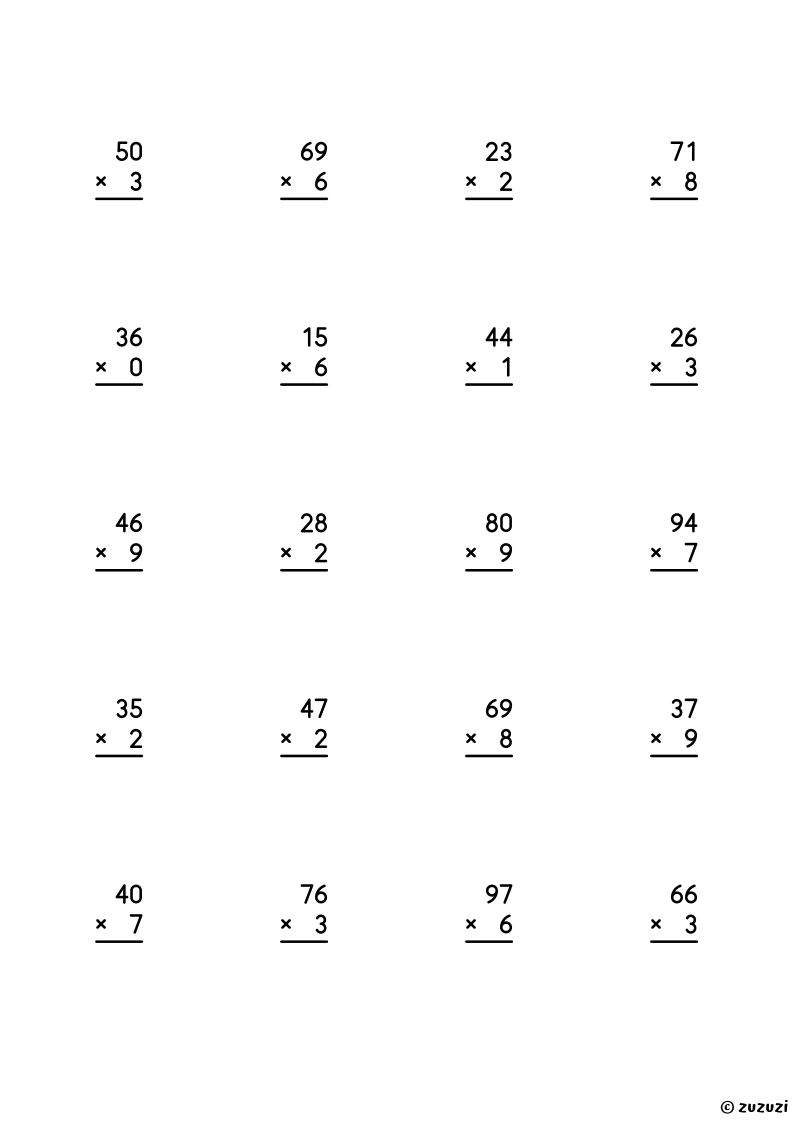
Choose the size of the two numbers. Every worksheet has twenty different multiplications, or sixteen with a second number of two or three digits, written in columns. Press New for another worksheet, then print it.
Frequently Asked Questions
What Can You Make With the Multiplication Worksheet Generator?
Printable worksheets of multiplications written in columns, from a two-digit number times a one-digit number to a four-digit number times a three-digit number, in 6 levels: twenty per page, or sixteen when the second number has two or three digits. Every worksheet also has its answer key, with the carries, the partial products and the products.
Why Practice Long Multiplication?
Long multiplication is the written method for multiplying numbers too large to multiply in your head. You multiply the top number by each digit of the bottom number, starting with the ones, and write each result, called a partial product, on its own line: the one for the tens digit is worth ten times more, and the one for the hundreds digit a hundred times more. Then you add the partial products. It puts the times tables, place value and column addition to work together. The answer key shows every carry and, with a two- or three-digit bottom number, every partial product and their sum, so you can see exactly where a mistake slipped in.
How Does the Multiplication Worksheet Generator Work?
- Choose the settings. Pick the size of the two numbers, from 2-digit by 1-digit to 4-digit by 3-digit.
- Make a new worksheet. Press New: a new worksheet appears at once, with the same settings. Each one comes from a random number, its seed, kept in the address of the page.
- Print it. Press Print to print the page on A4 paper, or choose “Save as PDF” in the print window to keep it.
- Get the answer key. Tick Show the solution: the same worksheet appears with its solution in orange, ready to print as the answer key.
- Share it. Copy the address of the page: it always gives the same worksheet back.
Every worksheet has twenty different multiplications, written in columns, with at most one multiplication by 0 and one by 1. With a second number of two or three digits, it has sixteen, in four rows, to leave room for the carries, the partial products and their sum. The page is made in your browser: nothing is sent to Zuzuzi, and it is free, with no sign-up.