
Area and Perimeter Worksheet Generator
Make an area and perimeter worksheet to print, each shape drawn to scale with its lengths: rectangles, shapes cut in L, U, T or steps, triangles, parallelograms, trapezoids, or a mix of them.
Ask for the area, the perimeter or both, in centimeters, meters, inches or feet. Every side, height and answer is a whole number, and the level only sets how large the numbers get.
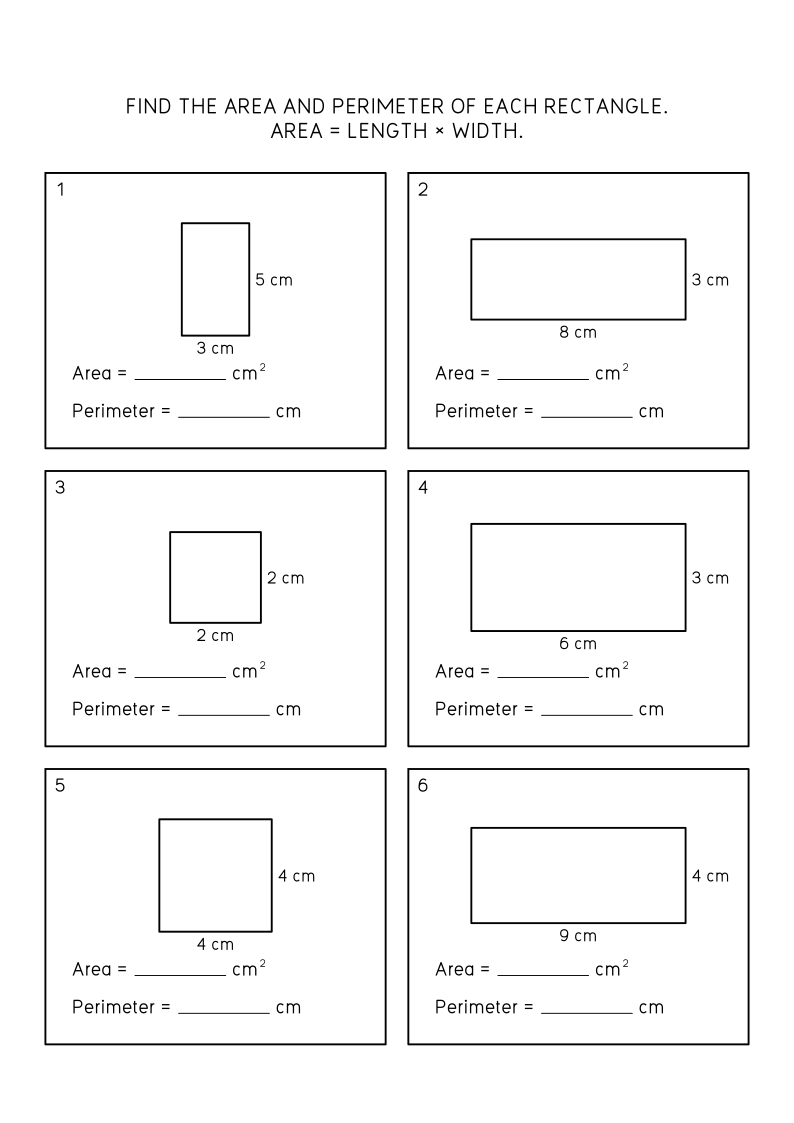
This browser is too old to make the page: please update it, or use another one. Here is an example page in the meantime.
The latest printable pages whose sheets were made with this generator, ready to download.


Frequently Asked Questions
What Can You Make With the Area and Perimeter Worksheet Generator?
Worksheets on six kinds of shapes. Rectangles; Rectilinear Shapes, which are rectangles with one or two notches cut out, in L, U or T or in steps; Triangles, right-angled or not; Parallelograms; Trapezoids, with or without a right angle; and Mixed Shapes, which shares a page between rectangles, triangles, parallelograms and trapezoids. A page has six shapes, three for the rectilinear ones, which need the full width.
How Can Slanted Sides Have Whole Number Lengths?
Every slanted side is the long side of a right triangle whose three sides are whole numbers, such as 3, 4 and 5 or 5, 12 and 13. The generator builds each triangle, parallelogram and trapezoid from such triangles standing on the same height. So the base, the height and all the sides are whole numbers at once, and the shape is still drawn at its true proportions.
What Does the Dashed Line Inside a Shape Mean?
It is the height, drawn from a corner straight down to the base, with a small square where it meets it at a right angle. It appears whenever the area is asked and no side already stands upright. On Hard pages the height of some triangles falls outside: the base is then extended in dashes to meet it.
Why Do Some Sides Have No Length?
Because you can work them out. A rectangle or a parallelogram shows one side of each pair, the opposite side being equal. A rectilinear shape hides one side across and one side down: the sides that run across add up to the same total in both directions, and so do the sides that run down. Finding those two sides is the first step, before the area or the perimeter.
What Do the Unit Squares Do?
Tick Unit squares, with rectangles or rectilinear shapes, to fill each shape with squares one unit wide. The area can then be counted square by square before it is multiplied, the way area is first taught. The side lengths stay written around the shape.
How Hard Are the Three Levels?
The level changes the size of the numbers, never the kind of shape. Easy rectangles have sides from 2 to 9; Medium, up to 15; Hard, from 10 to 19, for products of two-digit numbers. Triangles go up to sides of 25, 30 and 52, parallelograms to 15, 25 and 45, trapezoids to 20, 30 and 48. Hard triangles are drawn larger, four to a page.
How Does the Area and Perimeter Worksheet Generator Work?
- Choose Shapes, then Find: Area and Perimeter, Area, or Perimeter.
- Adjust Level and Unit, the lettering, the unit squares and the instruction lines.
- Hit New until the shapes suit you, then Print, once as it is and once with Show the solution to keep the answers.
Nothing to download and no login: the worksheet appears right on the page, for free.