
DNA Worksheet Generator
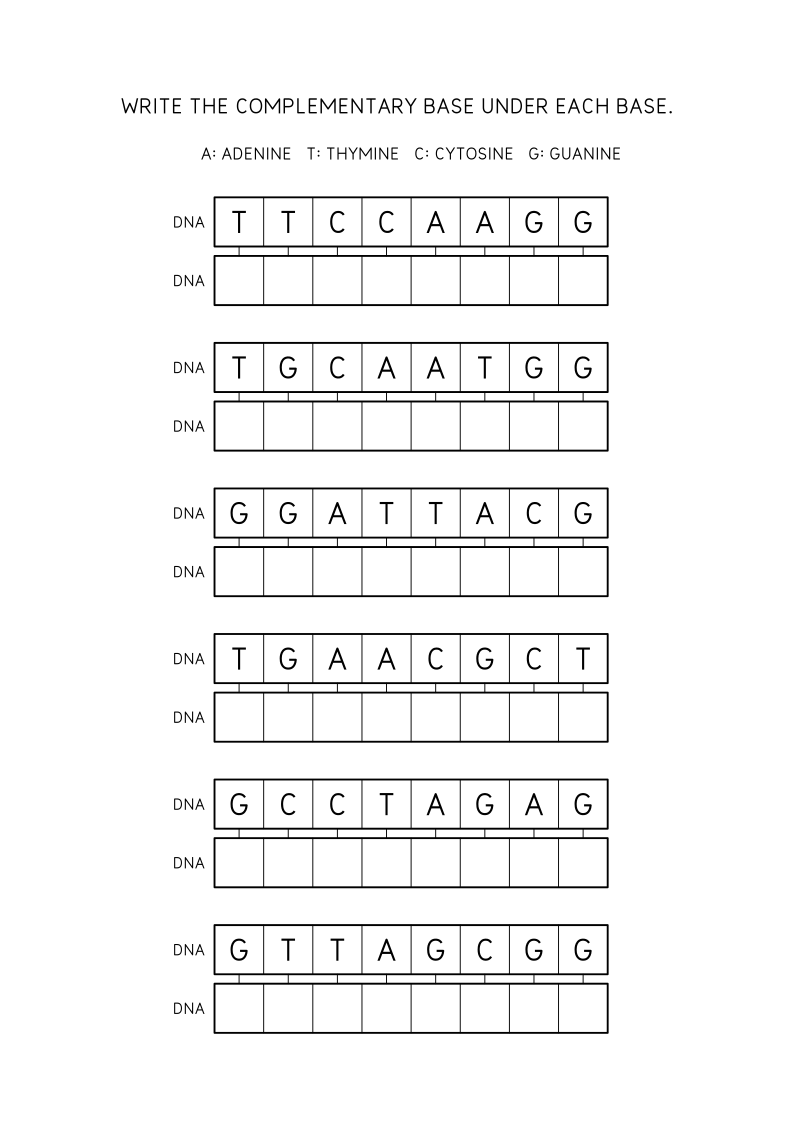
Make DNA worksheets to print: each exercise is a strand of DNA, its bases written in a row of boxes, with an empty row underneath for the matching strand. Students write the base that pairs with each one, adenine with thymine and cytosine with guanine, the rule that holds the two strands of the double helix together.
Choose strands of 8, 12 or 16 bases, and one of two exercises: the complementary DNA strand, or the transcription into RNA, where uracil takes the place of thymine. Each page draws new strands at random, with a legend of the bases and a solution on demand.
This browser is too old to make the page: please update it, or use another one. Here is an example page in the meantime.
The latest printable pages whose sheets were made with this generator, ready to download.


Frequently Asked Questions
What Can You Make With the DNA Worksheet Generator?
Practice sheets on base pairing for biology lessons: 6 strands of 8 or 12 bases per page, or 7 strands of 16 bases. Every strand sits in a row of boxes above an empty row of the same length, joined to it box by box by a short line, like the bonds between two bases. A line at the top of the sheet names the four bases.
What Is the Base Pairing Rule?
DNA is written with four bases: adenine (A), thymine (T), cytosine (C) and guanine (G). In the double helix, each base on one strand faces a fixed partner on the other: A always pairs with T, and C always pairs with G. Two hydrogen bonds hold an A to a T, and three hold a C to a G. Knowing one strand is therefore enough to write the other, which is what the worksheet asks.
How Do You Find the Complementary Strand?
Go through the strand one base at a time and write its partner in the box below: T under A, A under T, G under C, C under G. The strand ATCG becomes TAGC. A quick check at the end: the answer has as many A's as the question has T's, and as many C's as it has G's.
What Changes in the RNA Transcription Exercise?
The lower row is labeled RNA, and it is filled with the bases of the messenger RNA that a cell would build along this strand. RNA has no thymine: it uses uracil (U) instead. So A is copied as U, T as A, C as G and G as C, and the strand ATCG gives UAGC. The legend of the sheet then lists five bases, uracil included.
Which Strand Length Should I Choose?
Strands of 8 bases come in boxes of 13 mm with large letters, a good start when the pairing rule is new. Strands of 12 bases use boxes of 12 mm. Strands of 16 bases fill the width of the sheet with boxes of 10 mm and add a seventh exercise, for students who know the rule and need to work quickly and without slips.
How Are the Strands Chosen?
Each base is drawn at random, with three limits that keep the exercise fair: no base appears more than twice in a row, every strand contains all four bases, and no strand is repeated on a page. The seed of the page decides the draw, so a page keeps its strands when you switch between the two exercises or show the solution.
How Does the Solution Look?
Check Show the solution and the answers appear in the empty boxes, written in dashed orange letters. On a black and white printer they stay easy to tell from the printed bases, because they are dashed. Print the page once without them for the students and once with them for marking.
Who Is This Worksheet For?
For students meeting the structure of DNA for the first time, usually in middle school and high school biology, and for anyone reviewing genetics before a test. The complementary strand comes first; transcription follows once the difference between DNA and RNA has been taught. Because every page is new, a class can practice until the rule is automatic, each student on a different sheet.
How Does the DNA Worksheet Generator Work?
Pick a strand length and an exercise, then press New for other strands, or Print for the page you see. The instruction line at the top can be hidden with Show the instructions, for a test where the task is given aloud. The address of the page keeps its settings and its seed: saved or shared, it brings back the same strands.