
Pascal's Triangle – 16 Rows (12 Printables)
Twelve sheets of Pascal's triangle in sixteen rows, twelve blanks of two digits at most and smaller cells, for the most complete Sierpinski picture after the coloring.
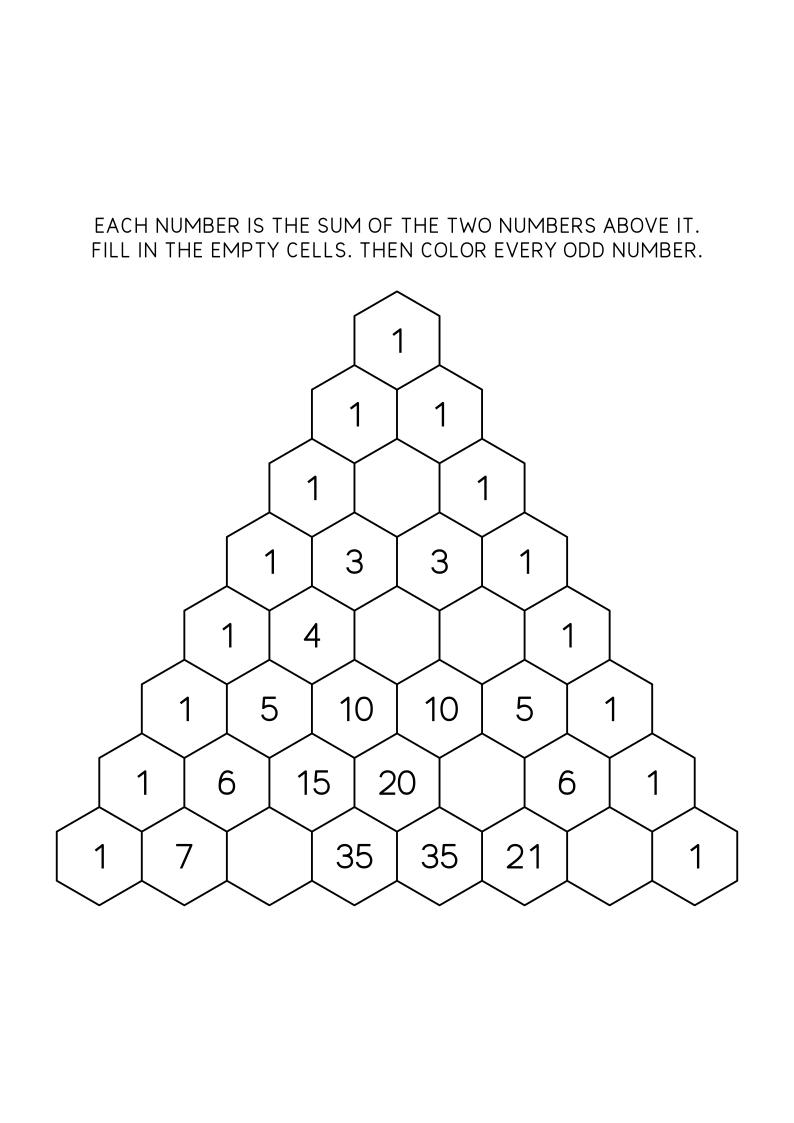
Make Pascal's triangle worksheets to print: a triangle of hexagonal cells where every number is the sum of the two numbers touching it from above, with a 1 at each end of every row. A few numbers are missing. The child works out each one from its two neighbors above, then colors every odd number, and the Sierpinski triangle appears.
Choose 8, 12 or 16 rows, for six, nine or twelve numbers to find. The instructions at the top of the sheet can be hidden, and the answer key writes the missing numbers in orange dots and rings every odd cell. The numbers in the hexagons and the instructions at the top come in Pebble or in Granite, chosen with Font, and the cells stay put.
Pascal's triangle is known as Yang Hui's triangle in China, as Khayyam's triangle in Iran and as Tartaglia's triangle in Italy.
Version 3. Last updated on Mon, 02 Nov 2026.
The latest printable pages whose sheets were made with this generator, ready to download.
Twelve sheets of Pascal's triangle in sixteen rows, twelve blanks of two digits at most and smaller cells, for the most complete Sierpinski picture after the coloring.

Twelve sheets of Pascal's triangle in twelve rows, nine blanks each, with numbers that grow to three digits and a pattern of odd cells that stops halfway through a step.

Twelve sheets of Pascal's triangle in eight rows, each with six missing numbers below 40 and large hexagonal cells, ready for a first try at the triangle and its pattern.
A worksheet of Pascal's triangle in 8, 12 or 16 rows, with six, nine or twelve numbers to fill in, and its answer key. Two lines of instructions at the top say what to do; uncheck Show the instructions for a sheet without them, and the triangle is then centered on its own.
A triangle of numbers that grows from a single 1 at the top: each row starts and ends with 1, and every number inside it is the sum of the two above it. Its rows hold the binomial coefficients, which count the ways to choose a few things from a group: the row 1, 4, 6, 4, 1 says there are 6 ways to pick two items out of four. It is named after Blaise Pascal, whose treatise about it came out in 1665, yet it was known centuries earlier, hence its other names: Yang Hui's triangle in China, after a mathematician of the 13th century, Khayyam's triangle in Iran, after the poet and mathematician Omar Khayyam, and Tartaglia's triangle in Italy, where Niccolò Tartaglia printed its first rows in 1556.
Never on the edges, where every number is 1, nor in the first two rows. The two numbers above a missing one always stay on the sheet, so each blank is a single addition away, and no two blanks touch from above or below. A row has two blanks at most, and each missing number has two digits at most with 8 or 16 rows, three with 12 rows, small enough to write by hand in its cell.
Odd plus even makes odd, while odd plus odd and even plus even both make even. Only this parity decides the colors, so the same pattern repeats at every size: the odd cells form triangles within triangles, the Sierpinski triangle. With 8 or 16 rows the pattern comes out complete, with 27 or 81 odd cells, while 12 rows stop halfway through a step.
Many. The numbers of each row add up to a power of 2: 1, 2, 4, 8, 16 and so on. The second diagonal counts 1, 2, 3, 4, and the third lists the triangular numbers, 1, 3, 6, 10, 15, the dots of ever larger triangles. Adding the numbers along the shallow diagonals gives the Fibonacci sequence, 1, 1, 2, 3, 5, 8, and a run down a diagonal, starting from the 1 at its edge, adds up to the number just below its last term on the other side, as 1 + 2 + 3 + 4 = 10: the hockey stick pattern.
Eight rows suit a first try: six small numbers to find and large cells to write and color in. Twelve rows bring nine numbers to find, up to three digits long. Sixteen rows give twelve numbers in smaller cells, and the richest pattern once the odd cells are colored.
Show the solution fills each blank with its number in orange dots and outlines every odd cell with a ring of dots, so the key gives both the additions and the coloring at once. Comparing a colored sheet with the key shows the Sierpinski pattern the child should have found.
Filling the blanks only takes adding two numbers, so the 8-row sheet, whose numbers stay below 40, suits children from about second grade, and the 12- and 16-row sheets fit third and fourth graders. The patterns reach much further: the same numbers count combinations in middle and high school, and they give the coefficients of the binomial theorem in algebra.
The generator computes each row from the one above it. A seed, the number in the address of the sheet, then sets the order in which it tries the inner cells: each cell that keeps the rules is left blank, until the sheet has as many blanks as its rows call for, stepping back in the rare case where the first choice runs out. New draws another seed, and the address keeps the current one, so the sheet can be printed again with the very same blanks. The answer key is computed, never typed.