
Math Maze Generator
Make math mazes to print: a grid of boxes, each with a calculation and a result. Only some of the results are correct, and the boxes that carry them form a path from the door at the top of the grid to the door at the bottom. The student steps from box to box, up, down, left or right, working out each calculation on the way. That path is the only one, without a shortcut or a dead end: at every step, exactly one new neighbor is correct.
Operation chooses Addition, Subtraction, Multiplication, Division, or Mixed, the four on one page. Target Number changes the game: the boxes show a calculation without its result, and the path follows those that make the number of the page, 44 for example. Level sets the numbers. Easy pages add and subtract single digits, and keep to the 2, 3, 4, 5 and 10 times tables; Medium pages bring in two-digit numbers and the times tables from 6 to 10; Hard pages pair two-digit numbers, and take 11 to 19 times a one-digit number. Size sets the grid: Small has 20 boxes, Medium 30, Large 48 and Very Large 63. A page never repeats a calculation, and each wrong result is a believable slip.
Start and finish marks the two doors with a pair of words (START with FINISH or END, or IN with OUT), with an arrow and a circle, with two arrows, or with nothing. Two settings remain, Font, with Pebble and Granite, and Show the instructions. Show the solution shades the boxes of the path in light gray and lines it with orange dashes, and New draws another maze.
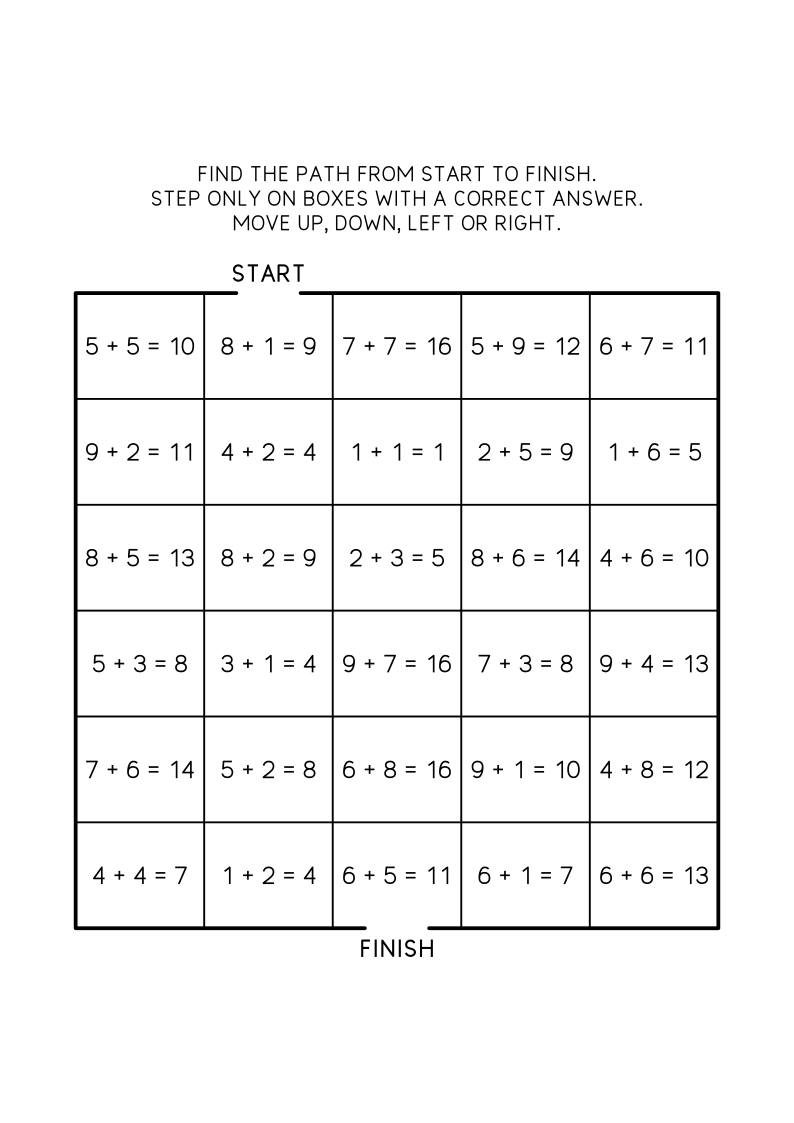
This browser is too old to make the page: please update it, or use another one. Here is an example page in the meantime.
Frequently Asked Questions
What Is a Math Maze?
A math maze is a practice page disguised as a puzzle. Instead of walls, the maze is made of calculations: every box of the grid shows one with a result, such as 7 + 5 = 12 or 6 × 7 = 43, and a box may be walked on only if its result is correct. The correct boxes join into one winding path that crosses the grid from its top row to its bottom row; all the others are traps.
To find the path, the student has to check the boxes around the one where they stand, so a single page asks for many more calculations than the path is long, without the page ever looking like a list of exercises. Teachers also call it a math fact maze or an answer maze.
How Do You Solve a Math Maze?
- Enter by the door at the top. The thick frame opens above one box, under the word START: its result is correct.
- Check the boxes next to it. Work out the calculation of each neighbor, to the left, to the right and below, and compare it with the result printed in the box.
- Step on the correct one. Exactly one new neighbor is correct each time. Color the box or draw a line into it.
- Keep going to FINISH. The path turns often and may climb back up before it comes down to the last row, where the frame opens again.
Moves go through the sides of the boxes only, never corner to corner. If two neighbors look correct, or none does, one of the calculations just made is wrong: check them again before going on.
Is a Math Maze Self-Checking?
For the most part, and that is why teachers like it. There is a single path and nothing else is correct: the boxes of the path never touch one another except in the order of the walk, so the path has no shortcut, no loop and no dead end. A student who rejects a correct result finds no way forward at all, since every other neighbor is wrong: the page itself says that the last calculations must be done again.
A student who accepts a wrong result, on the other hand, simply leaves the path, and the page cannot stop that. For this case there is the key. With Show the solution on, the boxes of the path turn a light gray that still shows on a black and white printer, between two lines of orange dashes that run from one door to the other: a glance tells whether the colored boxes of the student stay inside it.
What Numbers Does Each Level Use?
- Addition: Easy adds two single digits, with sums up to 18; Medium puts a two-digit number with a one-digit number, staying under 100; Hard adds two two-digit numbers, such as 47 + 38.
- Subtraction: Easy takes 1 to 9 from a number up to 18 and leaves a single digit; Medium removes a one-digit number from one of two digits; Hard subtracts one two-digit number from another, such as 82 − 47.
- Multiplication: Easy covers the tables of 2, 3, 4, 5 and 10, up to ten times; Medium the tables of 6 to 10; Hard multiplies a number from 11 to 19 by a single digit, such as 14 × 7.
- Division: Easy and Medium are the same tables read backward, 35 ÷ 5 or 56 ÷ 8; Hard gives quotients from 11 to 19, such as 98 ÷ 7.
Every division comes out even and no subtraction goes below zero. Mixed keeps the level and draws the operation of each box among the four.
How Are the Wrong Answers Chosen?
Each wrong result is one that a child could really write, so the traps cannot be spotted at a glance. It is the correct result plus or minus 1 or 2, as after a slip in counting; plus or minus 10, as after a lost or an extra ten, for additions and subtractions above Easy and for the Hard tables; or, for a multiplication, the product of the next line of the table: 6 × 7 may show 35, 36, 48 or 49, the results of 5 × 7, 6 × 6, 6 × 8 and 7 × 7.
A wrong result is never negative, never zero for a product or a quotient, and never equal to the correct one, so each box is plainly correct or plainly wrong once the calculation is done.
Which Size Should You Choose?
- Small: 4 columns and 5 rows, 20 boxes, a path of 8 to 12 boxes, and the largest digits. A warm-up, or a first maze for a young child.
- Medium: 5 columns and 6 rows, 30 boxes, a path of 12 to 18.
- Large: 6 columns and 8 rows, 48 boxes, a path of 20 to 28: a full practice session.
- Very Large: 7 columns and 9 rows, 63 boxes, a path of 26 to 37: the biggest grid the page can hold, for a long session or a group.
The path winds enough for a careful student to check almost every box on the way: on average about 18 of the 20 boxes of a Small maze, 27 of the 30 of a Medium one, 43 of the 48 of a Large one and 57 of the 63 of a Very Large one.
When the numbers are long, the calculation is printed on one line and its result on the next, after the equals sign, so that the digits stay at least 4.2 mm high, or 3.5 mm in the Very Large grid.
How Many Different Mazes Can It Make?
The entrance can be above any box of the top row and the exit below any box of the bottom row, and the path between them changes with every press of New. Counting only its shape, a Small grid has several hundred possible paths, a Medium one several thousand, a Large one more than two hundred thousand, and a Very Large one close to fifteen million. The calculations are drawn again as well, and so are the wrong results, so two pages with the same settings are never the same exercise.
That is useful in class: neighbors can each get a different maze of the same level, and a child who wants another try gets new numbers instead of a path already known.
When Should You Use the Mixed Operation?
Mixed puts additions, subtractions, multiplications and divisions on the same page, each box drawing its operation at random. The student must read the sign before computing, which is exactly what a page of a single operation never asks for. Keep it for review, once each operation has been practiced alone at the same level: Easy mixes single-digit sums and differences with the first tables, and Hard mixes two-digit additions and subtractions with products and quotients of numbers from 11 to 19.
What Is a Target Number Maze?
With Operation set to Target Number, the boxes no longer show a result. Each one shows a calculation alone, and the page gives one number, printed large above the grid: “= 44”. The path is made of the boxes that make that number, by any of the four operations: 40 + 4, 50 − 6, 4 × 11 and 88 ÷ 2 all belong to the path of 44. The other boxes miss it narrowly, by 1, by 2 or by 10, so 39 + 4 or 108 ÷ 2 cannot be told apart from the right ones without computing.
Level sets the size of the number: 10 to 20 on Easy pages, 21 to 50 on Medium ones, 51 to 99 on Hard ones. It is the same idea as the “ways to make 10” that young children practice, extended to the four operations: the student meets many different calculations with one and the same answer, which trains estimating before computing.
How Are the Start and the Finish Marked?
The thick frame of the grid has two openings, one above a box of the top row and one below a box of the bottom row: these doors are the real start and finish, on every page. Start and finish chooses what is printed in front of them: the words START and FINISH, START and END, or IN and OUT; an arrow at the entrance and a circle at the exit; two arrows; or None, which leaves the doors to be found. The first line of the instructions follows the choice, from “Find the path from the arrow to the circle” to “Find the path from top to bottom”.
Words suit readers, the arrow and the circle suit younger children and classes where English is being learned, and None turns the search for the entrance into the first step of the puzzle.
How Do Teachers Use Math Mazes?
As fact practice that students ask for. A maze fits a math center, the first minutes of a lesson, homework, or the pile for early finishers, and since most slips show on the page itself, it frees the teacher for the students who need help. Two children can also share one maze and justify each step to the other.
The levels follow the usual order of fluency. The Common Core State Standards expect students to add and subtract fluently within 20 before grade 2 is over (2.OA.B.2), the ground of the Easy additions and subtractions, and to multiply and divide fluently within 100 before grade 3 is over (3.OA.C.7), the ground of the Easy and Medium tables. The Hard pages, with their two-digit numbers, suit the following years.