
Length Conversion Worksheet Generator
Make length conversion worksheets to print, in metric or US customary units. Exercise offers Convert, where each line reads like 3 m = ____ cm, and Compare (<, >, =), where two lengths face each other across a box for the sign, such as 4 ft and 50 in. System picks the family of units: millimeters, centimeters, decimeters, meters and kilometers, or inches, feet, yards and miles. Units narrows the page to one pair, such as Feet and Yards, or mixes every pair of the system with All Units.
Convert decides the direction of every line: multiplying into the smaller unit, dividing into the larger one, or a mix of both. Numbers chooses whole numbers, decimals in metric units, or two units at once, such as 2 m 35 cm or 5 ft 7 in. Problems prints 10, 20 or 30 lines; Sign box frames each sign in a circle, square or rectangle; Thousands separator writes 5,280 or 5280; Conversion chart lists the facts the page uses, such as 1 mi = 5,280 ft; Line numbers numbers the problems, Show the instructions prints the step to take, and Font picks Pebble or Granite.
Every answer comes out exact, and Show the solution writes each one in orange.
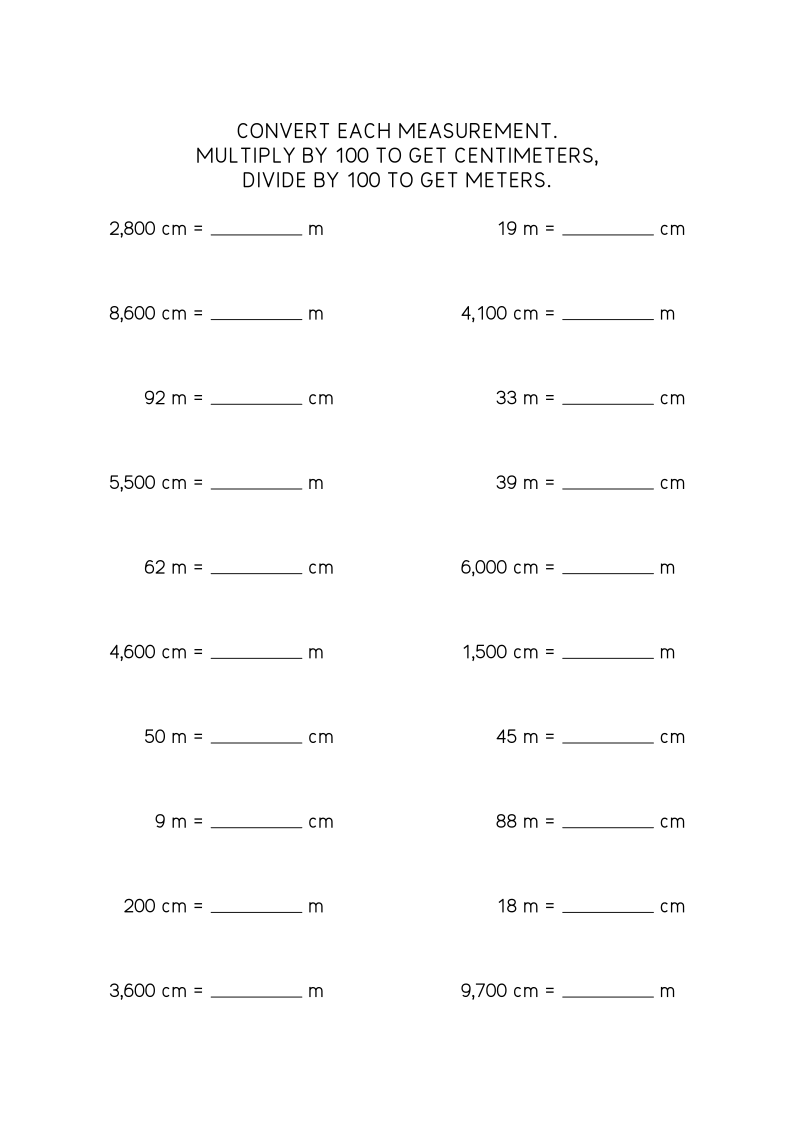
This browser is too old to make the page: please update it, or use another one. Here is an example page in the meantime.
The latest printable pages whose sheets were made with this generator, ready to download.


Frequently Asked Questions
How Do You Convert Between Units of Length?
Going to a smaller unit, multiply, since it takes more of the small unit to cover the same length: 3 m = 300 cm. Going to a larger unit, divide: 48 in = 4 ft. For one pair of units the instructions give the exact step, such as 1 FOOT = 12 INCHES: MULTIPLY BY 12. Convert sets the direction: every problem toward the smaller unit, every problem toward the larger one, or Both Ways, half and half. A page never holds a problem together with its reverse, so one line cannot give away the answer of another.
How Many Inches, Feet and Yards Are in a Mile?
A foot is 12 inches, a yard is 3 feet or 36 inches, and a mile is 5,280 feet or 1,760 yards. The customary pairs of the Units menu use exactly those facts, from Inches and Feet up to Yards and Miles. The number 5,280 is the one children forget most; some remember it as five tomatoes, said aloud as 5-2-8-0. Problems with miles reach thousands of feet, which is where the thousands separator starts to matter.
What Do Milli, Centi, Deci and Kilo Mean?
They are the prefixes of the metric system: milli means a thousandth, centi a hundredth, deci a tenth and kilo a thousand. So a meter holds 10 decimeters, 100 centimeters or 1,000 millimeters, and a kilometer holds 1,000 meters. Because every step is a power of ten, a metric conversion only moves the decimal point: 4.5 m is 450 cm. The metric pairs of the menu are Millimeters and Centimeters, Centimeters and Decimeters, Decimeters and Meters, Centimeters and Meters, Meters and Kilometers, and Millimeters and Meters; the decimeter is rare in the US but common in many European classrooms.
How Do Decimal Lengths Work on These Pages?
With Numbers set to Decimals, the larger unit carries one, two or three decimal places: from 0.1 to 19.9, from 0.01 to 9.99, or from 0.001 to 4.999. A length never has more decimal places than its ratio has zeros, so the smaller unit always comes out whole: 2.35 m = 235 cm, but no line asks for 2.356 m in centimeters. A page shares its lines between the decimal places its pair allows. Decimals are offered with metric units only, since 12 inches and 3 feet do not divide into tenths.
How Do You Convert a Length Written in Two Units?
Turn the larger unit into the smaller one, then add what is left: 5 ft 7 in is 5 × 12 + 7 = 67 in, and 2 m 35 cm is 235 cm. Going the other way, divide and keep the remainder: 67 in is 5 ft with 7 in left over, so the answer has two lines, one for each unit. These problems use 1 to 9 of the larger unit, up to 16 yards when the feet have only two values left, and for miles in feet the leftover runs by hundreds, such as 3 mi 5,100 ft. Feet and inches is the way heights are given in the US, which makes this the most useful setting outside school.
How Do the Comparison Problems Work?
Each line sets a length in the larger unit against one in the smaller unit, such as 3 ft and 48 in, on either side of a sign box, round, square or wide as Sign box sets it, where the child writes <, > or =. Converting one side first settles it: 3 ft is 36 in, so 3 ft < 48 in. The two lengths are always close, never more than three steps apart in the list of lengths of their pair, so guessing by the size of the numbers does not work. The three signs come up equally often, the larger unit sits on the left or the right at random, and a length in two units always stands on the left.
What Is the Conversion Chart?
A framed box above the problems with the fact of every pair the page uses, so the child does not need to know them by heart. For All Units in customary lengths it reads 1 ft = 12 in, 1 yd = 3 ft, 1 yd = 36 in, 1 mi = 5,280 ft and 1 mi = 1,760 yd; for Meters and Kilometers, simply 1 km = 1,000 m. With the chart on the page, the instructions drop the fact and keep only the step, such as MULTIPLY BY 1,000. Leaving the chart off turns the same page into a memory test.
Why Turn Off the Thousands Separator?
Because not every country writes 5,280 with a comma: many write 5 280 with a space, or 5.280 with a point, and a comma there would read as a decimal mark. Choosing None (1000) prints every number without a separator, which avoids the confusion. The setting appears only with the pairs that can reach 1,000 or more: Centimeters and Meters, Meters and Kilometers, Millimeters and Meters, Inches and Yards, Feet and Miles, Yards and Miles, and All Units.
Are US Customary and Metric Lengths Ever Mixed?
Not on these pages: each problem stays inside one system, as conversion lessons usually do, and System decides which. The two systems are linked by an exact definition, though: one inch is 2.54 cm, so a foot is 30.48 cm and a mile is about 1.609 km. Inches, feet, yards and miles have the same length in the US and in the British imperial system, so the customary pages work for both.
Can One Page Mix All the Units?
Yes: with All Units, the lines are shared equally between every pair of the system, then between the two directions, so a page of Feet and Miles next to Inches and Feet makes a full review. Problems sets ten, twenty or thirty lines, in two columns, all different. Whole numbers go from 2 up to 99 of the larger unit for metric pairs and up to 32 to 40 for customary ones, which leaves enough different problems to fill thirty lines. Line numbers adds a number before every problem, handy when answers are read out or marked.
When Do Children Learn to Convert Lengths?
The US Common Core starts in fourth grade, with the relative sizes of units within one system, such as km, m and cm, and with writing a measurement in a smaller unit, often in a two-column table of feet and inches; fifth graders convert in both directions, with decimals, such as 5 cm = 0.05 m, and use it in word problems. In England, Year 4 converts kilometers and meters, Year 5 the other metric units, and Year 6 converts with up to three decimal places, the most this generator uses.