
Time Conversion Worksheet Generator
Make time conversion worksheets to print, from seconds up to centuries. Units chooses one of nine pairs: Seconds and Minutes, Minutes and Hours, Hours and Days, Days and Weeks, Months and Years, Weeks and Years, Days and Years, Years and Decades, or Years and Centuries, and All Units mixes them on one page. Exercise switches between Convert, with lines like 3 h = ____ min, and Compare (<, >, =), with pairs like 3 h and 175 min.
Time is the one measure that does not count in tens, so each pair has its own number: 60, 24, 7, 12, 52, 365, 10 or 100. Numbers gives whole numbers or durations in two units, such as 2 h 30 min, and never decimals. Convert, Problems, Sign box and Thousands separator set the direction, the length of the page, the shape around each sign and how 2,160 is written; Conversion chart prints the facts in a box above the problems; and the problems can be numbered, the instructions shown or hidden, and the digits drawn in Pebble or Granite.
Show the solution fills every answer line in orange.
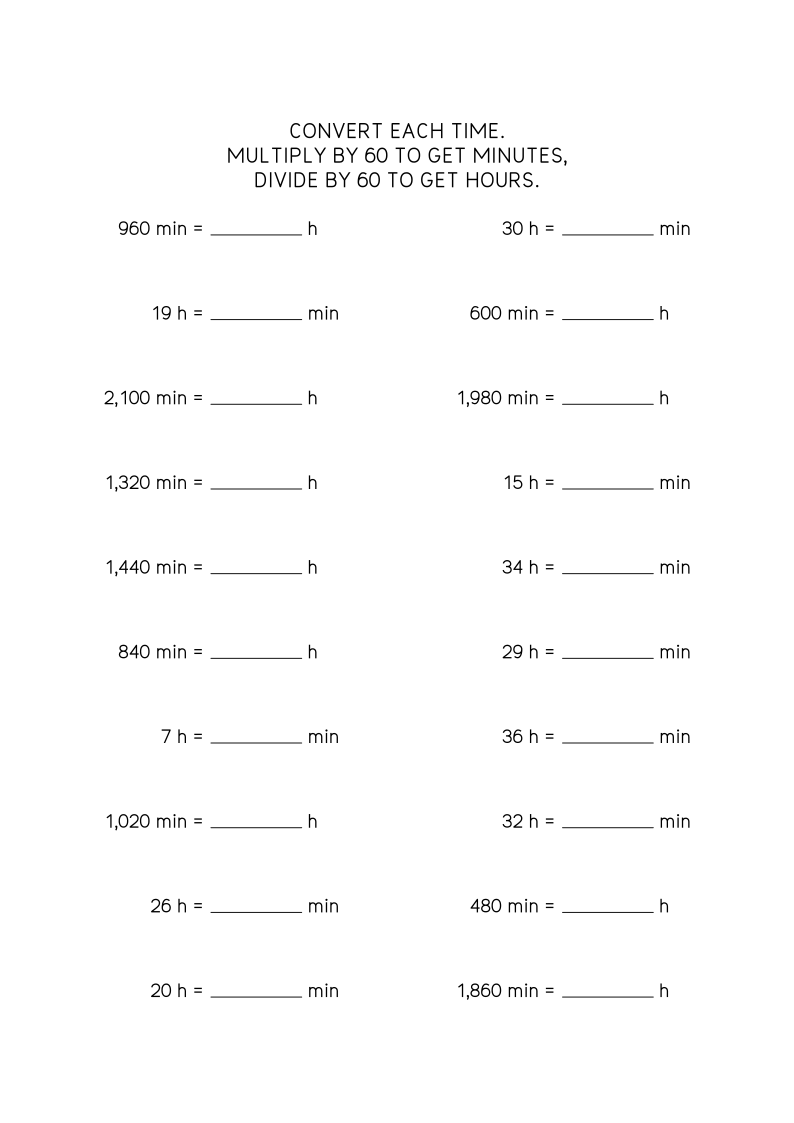
This browser is too old to make the page: please update it, or use another one. Here is an example page in the meantime.
The latest printable pages whose sheets were made with this generator, ready to download.


Frequently Asked Questions
Why Does Time Not Count in Tens?
Because its units are far older than the decimal system. Minutes and seconds come from the base 60 of ancient Babylonian astronomers, chosen because 60 divides evenly by 2, 3, 4, 5, 6, 10, 12, 15, 20 and 30. The 24 hours go back to Egypt, where day and night each had 12 hours; the seven-day week comes from ancient calendars; months and years follow the Moon and the Sun. Only decades and centuries are tens. That is why a time conversion multiplies or divides by 60, 24, 7, 12, 52 or 365, and never just moves a decimal point.
Which Time Facts Do the Pages Use?
Nine, one per pair: 1 min = 60 s, 1 h = 60 min, 1 day = 24 h, 1 week = 7 days, 1 year = 12 months, 1 year = 52 weeks, 1 year = 365 days, 1 decade = 10 years and 1 century = 100 years. With Conversion chart ticked they appear in a framed box above the problems, only those of the pairs on the page, and the instructions then keep just the step, such as MULTIPLY BY 60. Chaining two facts gives the ones not on the menu, a good question to ask aloud: an hour is 3,600 seconds and a day 1,440 minutes.
Why Does a Year Count as 365 Days and 52 Weeks?
Those are the agreed school facts, and they keep every answer exact. A common year has 365 days, but every fourth year is a leap year of 366, except most century years. A year is also a little more than 52 weeks, since 52 × 7 is only 364. And months last from 28 to 31 days, which is why no pair converts months into days. Using 12, 52 and 365 gives each problem a single answer, the one children find in their textbooks.
How Do You Convert 2 h 30 min Into Minutes and Back?
Multiply the larger unit and add the rest: 2 × 60 + 30 = 150 minutes. In the opposite direction, divide and keep what is left over: 150 ÷ 60 is 2 with 30 left over, so 2 h 30 min, written on two answer lines, the larger unit first, as the instructions say. The same method works for every pair: 949 days are 2 years and 219 days, 31 h are 1 day and 7 h, and 3 centuries 94 years are 394 years. Numbers set to Two Units brings these problems; Whole Numbers keeps one unit on each side.
Why Is There No Decimal Option for Time?
Because a decimal of an hour is not a number of minutes: 1.5 hours is 1 hour 30 minutes, not 1 hour 50 minutes, and 2.25 hours is 2 hours 15 minutes. Mixing the two is one of the most common mistakes with time, on clocks, timetables and stopwatches alike. So Numbers offers only whole numbers or a mix of two units, the way people actually write and say times, and the decimal side of time is left for later lessons.
Which Is Longer, 3 Hours or 175 Minutes?
3 hours, since 3 h is 180 min, and 180 is more than 175: the child writes > in the box between them. That is how every line of Compare (<, >, =) works: one duration in the larger unit, one in the smaller unit, and a sign to find. The two durations are always close, within three steps of each other in the list for their pair, so the size of the numbers alone never gives the answer away. Greater than, less than and equal come up equally often, and Sign box sets the shape drawn around each sign.
When Do Time Answers Reach the Thousands?
With five of the nine pairs, seconds in minutes, minutes in hours, weeks in a year, days in a year and years in centuries, as well as All Units. 36 hours is 2,160 minutes, 6 years and 202 days is 2,392 days, and 25 centuries is 2,500 years. Only with those pairs does the page offer Thousands separator, to write the numbers with a comma, 2,160, or without one, 2160, as many countries prefer.
Why Are Some Units Written in Full?
Seconds, minutes and hours have short symbols, s, min and h, but days, weeks, months, years, decades and centuries do not, so the pages write them as words: 1 day, 3 days, 1 century, 9 centuries. A unit written in full takes the plural after every number but one. The longest lines, such as 9 centuries 99 years, take a lot of room, so a page that holds many of them is drawn slightly smaller as a whole rather than cut.
How Are the Problems Chosen?
From every duration that fits the pair: 2 to 36 of the larger unit for seconds, minutes, hours and months, 2 to 40 weeks for days, 2 to 99 decades or centuries, and 2 to 32 years for weeks or days in a year. A page of 10, 20 or 30 problems shares its lines equally between its pairs, then between the two directions, never repeats a problem, and never holds a problem next to its reverse, which would give the answer away. Line numbers can put a number before each line for marking.
When Do Children Learn to Convert Time?
The US Common Core has third graders tell time to the nearest minute and measure intervals in minutes; fourth graders learn that an hour is 60 minutes and a minute 60 seconds, write a time in a smaller unit, and solve word problems with intervals of time. In England, Year 2 knows the minutes in an hour and the hours in a day, Year 3 the seconds in a minute and the days in each month, year and leap year, Year 4 converts hours to minutes, and Years 5 and 6 solve problems that convert between units of time.