
Weight Conversion Worksheet Generator
Make weight conversion worksheets to print, from a milligram on a vitamin label to a ton on a truck scale. Metric pages pair milligrams with grams, grams with kilograms, or kilograms with metric tons, three steps of exactly 1,000 each; US customary pages pair ounces with pounds, 16 to the pound, or pounds with tons, 2,000 to the ton. All Units puts every pair of the chosen system on one page.
Each line is a conversion, such as 4 kg = ____ g, or a comparison, such as 2 lb and 30 oz, with a circle, a square or a rectangle to hold <, > or =. The direction, the kind of numbers, whole, decimal in metric units, or in two units such as 2 t 300 kg or 9 lb 15 oz, and the number of lines, 10, 20 or 30, are all settings. A framed chart of the facts, commas or none in large numbers, numbered lines, printed instructions and the Pebble or Granite lettering finish the page.
Answers are always exact, and Show the solution prints them in orange.
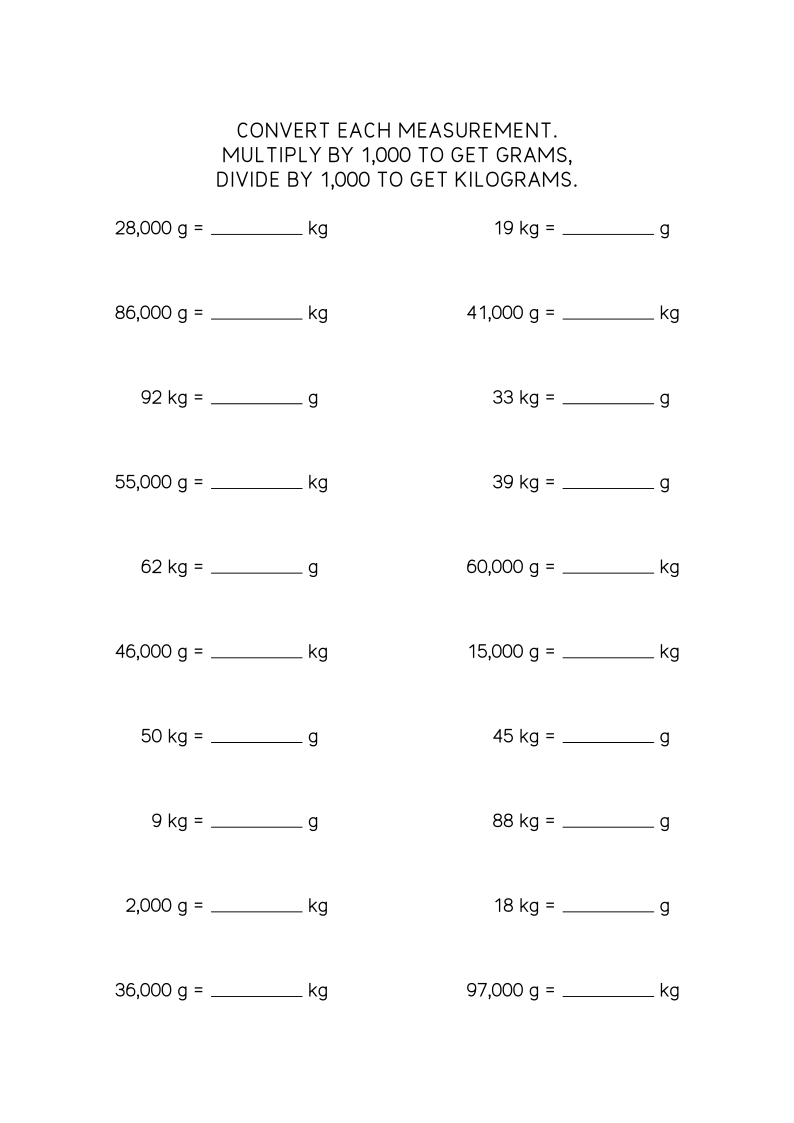
This browser is too old to make the page: please update it, or use another one. Here is an example page in the meantime.
The latest printable pages whose sheets were made with this generator, ready to download.


Frequently Asked Questions
How Many Ounces Are in a Pound, and Pounds in a Ton?
A pound is 16 ounces and a US ton is 2,000 pounds, so a ton is also 32,000 ounces, though no page asks for that last jump. Those two facts are all the customary chart needs: 1 lb = 16 oz and 1 T = 2,000 lb. Working with 16 makes pounds and ounces harder than metric weights, since 3 lb is 48 oz and 100 oz is 6 lb 4 oz; that is exactly the kind of step these pages practice, in both directions.
Is an Ounce the Same as a Fluid Ounce?
No, and the two are easy to mix up. The ounce of these pages is a unit of weight, about 28.35 grams, one sixteenth of a pound. A fluid ounce measures capacity, about 29.57 milliliters, and belongs with cups and pints. They happen to be close for water, which is why recipes sometimes blur them, but a fluid ounce of honey weighs about one and a half ounces. A weight page never mentions fluid ounces.
What Is the Difference Between a Ton and a Metric Ton?
A US ton, also called a short ton, is 2,000 pounds, about 907 kg. A metric ton, or tonne, is 1,000 kilograms, about 2,205 pounds. Britain used a third one, the long ton of 2,240 pounds. To keep them apart, the pages write T for the US ton and t for the metric ton, so 1 T = 2,000 lb sits on customary pages and 1 t = 1,000 kg on metric ones.
Is It Weight or Mass?
Strictly, grams and kilograms measure mass, the amount of matter in something, while weight is the pull of gravity on it, which would change on the Moon. School and everyday speech say weight for both, and so does this generator, but many curricula use mass for the metric units: US standards ask third graders to estimate the masses of objects in grams and kilograms, and English schools speak of mass throughout. The conversions are the same either way.
How Do You Convert Grams and Kilograms?
Every metric step is a thousand: 1 g is 1,000 mg, 1 kg is 1,000 g, and 1 t is 1,000 kg. Going to the smaller unit, multiply by 1,000: 4 kg = 4,000 g. Going to the larger unit, divide by 1,000: 6,000 g = 6 kg. With decimals, the point moves three places, so 2.5 kg is 2,500 g and 0.75 kg is 750 g. When the chart is printed, the instructions are cut down to the operation: MULTIPLY BY 1,000 or DIVIDE BY 1,000.
Which Decimals Can Appear?
With Numbers set to Decimals, metric only, a page mixes larger units with one decimal place, from 0.1 to 19.9, two, from 0.01 to 9.99, and three, from 0.001 to 4.999, in equal shares. Since every metric ratio here is 1,000, three places is the most a weight can have while its smaller unit stays whole: 3.25 kg is 3,250 g, and 0.005 kg is 5 g. Pounds and ounces have no decimals on these pages, as 16 does not divide into tenths.
How Do You Convert 3 kg 250 g or 5 lb 4 oz?
Multiply the larger unit, then add the smaller one: 3 kg 250 g is 3,000 + 250 = 3,250 g, and 5 lb 4 oz is 5 × 16 + 4 = 84 oz. For the reverse, divide and write what is left on a second line: 84 oz is 5 lb 4 oz. Tons and pounds work the same way, in hundreds of pounds: 3 T 400 lb is 6,400 lb. Pounds and ounces is how American babies and parcels are weighed, so this is the setting families meet most.
Which Is Heavier, 2 Pounds or 30 Ounces?
2 pounds, since 2 lb is 32 oz: the sign is >. Comparison pages pit a weight written in the bigger unit against a weight written in the smaller one, never far apart, so the numbers alone mislead and a conversion is needed every time; 5 lb 2 oz against 83 oz, for example, is 82 oz against 83. Each sign appears on a third of the lines, and a two-unit weight is always the left-hand one.
Why Do Weight Answers Run Into the Thousands?
Because a factor of 1,000 separates every metric unit, and 2,000 pounds make a ton: 99 kg is 99,000 g, and 32 tons are 64,000 lb. The page therefore offers Thousands separator with Milligrams and Grams, Grams and Kilograms, Kilograms and Metric Tons, Pounds and Tons, and All Units, to print 64,000 with its comma or 64000 without, whichever a class is used to. Only Ounces and Pounds stays below 1,000 and does without it.
How Do Pounds Compare With Kilograms?
A pound is defined as exactly 0.45359237 kg, so a kilogram is about 2.2 pounds and an ounce about 28.35 grams. These pages never mix the two systems: System picks metric or US customary, and every line stays inside it, the way conversion lessons are taught. Knowing that a kilogram is a little more than two pounds still helps a child judge whether an answer makes sense.
When Do Children Learn to Convert Weights?
US third graders measure and estimate masses in grams and kilograms; fourth graders learn how kilograms compare with grams and pounds with ounces, and write a measurement in the smaller unit; fifth graders convert both ways within one system to solve problems with several steps. English schools convert grams and kilograms in Year 5, alongside rough pound equivalents, and reach three decimal places in Year 6, which matches the decimals offered here.