
Letter Tracing Worksheet Generator
Make letter tracing worksheets to print, also known as handwriting or alphabet tracing worksheets, for any letter from A to Z. Each row starts with the letter in solid black, as a model, then goes on in dashed copies that the child traces with a pencil, on four guide lines like those of a handwriting notebook.
Choose the letter, then what to trace: the uppercase letter, the lowercase letter, both side by side, or short words that use the letter, from five lists, Everyday Words, Animals, Food and Kitchen, Things, and Countries and Cities, with the letter at the start of the word or further in. Letter Size makes the capitals 20, 15 or 11 mm tall, for seven, nine or twelve rows on the sheet, and Dashed Copies fills the rest of each row with copies, half of it, a single copy or none, leaving room to write the letter alone. Under Font, Pebble draws soft, rounded letters with the single-story a of handwriting, and Granite the letters of a printed book.
Show the name line and Show the date line add a line for each above the rows. The worksheet needs no answer key: the model at the start of each row shows the letter to write.
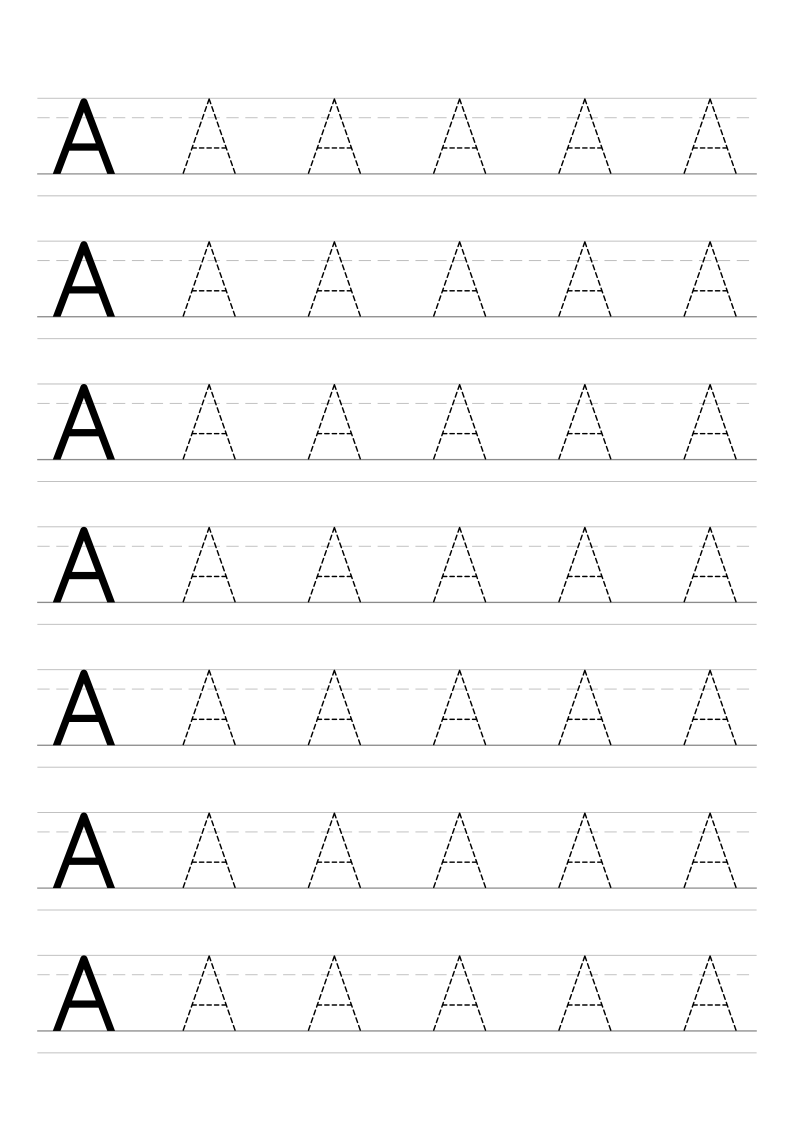
This browser is too old to make the page: please update it, or use another one. Here is an example page in the meantime.
The latest printable pages whose sheets were made with this generator, ready to download.


Frequently Asked Questions
What Can You Make With the Letter Tracing Worksheet Generator?
Handwriting sheets for one letter of the alphabet at a time: rows of the capital, of the small letter, of both, or of short words that use the letter, each row opening with a solid model and going on in dashed copies to trace. The letters come in three sizes, and the dashed part of each row can shrink from the whole line to nothing, from a first tracing to writing alone.
Why Practice Letter Tracing?
Tracing over a dashed letter shows the child its shape and the path of each stroke before they try it alone, while the hand learns to steer the pencil along a line. Copying the model, then writing the letter freehand, turns that path into a habit. Practicing the capital and the small letter side by side links the two shapes of one letter, and words show the letter at work.
What Are the Four Guide Lines For?
They give every letter its height, as in a handwriting notebook. Capitals and tall letters such as b, d, h and l reach the top line; small letters like a, c, e and o fill the space between the dashed middle line and the baseline, the darker line that every letter stands on; and g, j, p, q and y drop below the baseline to the bottom line. The dashed copies touch the same lines as the model, so the child learns where each letter sits as well as its shape.
What Does the Dashed Copies Setting Change?
How much of each row is dashed after the model. Whole line fills the row with copies to trace, for a first meeting with the letter. Half a line traces a few copies, then leaves the rest of the line empty to write the letter freehand. One keeps a single copy to trace, and None shows only the model, so the child copies it alone on the guide lines. Moving from one choice to the next over a few sheets turns tracing into writing.
Which Words Are in the Word Lists?
Short words that a young child can say and picture, in five lists that each have words for all 26 letters: Everyday Words like zoo and box, Animals like zebra and fox, Food and Kitchen like apple and pizza, Things like quilt and taxi, and Countries and Cities like Mexico and Paris, written with their capital letter. Letter in the Word picks words that start with the letter, or words that hold it further in, such as squid for Q. Few words start with X, so for X the words always hold it further in, as in fox or six. Each row writes one word, and the words take turns down the sheet.
Which Letter Size Should I Choose?
Large draws capitals 20 mm tall, seven rows to a sheet, for a first try at a letter, while the movement still needs room. Medium, 15 mm, gives nine rows, and Small, 11 mm, gives twelve, for children whose letters are already steady. Words come in Medium and Small only, so that a whole word fits on the line with its copies.
Pebble or Granite: Which Font Should I Use?
Pebble draws soft letters with even, rounded strokes and the single-story a that children write by hand. Granite draws the crisp letters of a printed book, with a two-story a, to practice the letters children meet when they read. Both fonts keep the same rows, the same guide lines and the same dashed copies.
What Age Is Letter Tracing For?
Letter tracing usually starts in preschool, around ages 3 to 5, and goes on in kindergarten. In the US Common Core, kindergarten children print many uppercase and lowercase letters, and first graders print all of them. Large letters with whole lines of copies suit the youngest writers; small letters, fewer copies and words suit children who already form their letters well.
How Does the Letter Tracing Worksheet Generator Work?
Every letter is drawn by the site’s own fonts as a vector shape, so it stays sharp at any print size. The dashed copies follow the line that the pen of the model draws, stretched so that they touch the same guide lines as the solid letter: the dashes run evenly around a round letter and meet at every corner. Nothing on the sheet is random: a link to the page keeps its settings and draws the very same sheet again.