
Capacity Conversion Worksheet Generator
Make capacity conversion worksheets to print, with the units of the kitchen, the bottle and the gas pump. In metric units the pages use milliliters, centiliters, deciliters and liters; in US customary units, fluid ounces, cups, pints, quarts and gallons, every pair of them, from Cups and Pints to Fluid Ounces and Gallons. Each page sticks to one pair, or mixes the whole system with All Units.
Exercise turns each line into a conversion, 3 qt = ____ pt, or a comparison, 3 pt and 7 c with a box for <, > or =. Convert, Numbers and Problems choose the direction, whole numbers, decimal liters or two units such as 2 L 500 mL, and ten, twenty or thirty lines. Conversion chart sets the facts of the page in a frame on top, from 1 c = 8 fl oz to 1 gal = 128 fl oz; Sign box, Thousands separator, Line numbers, the instructions and the font adjust the sheet itself.
Every answer is exact, and Show the solution writes it in orange.
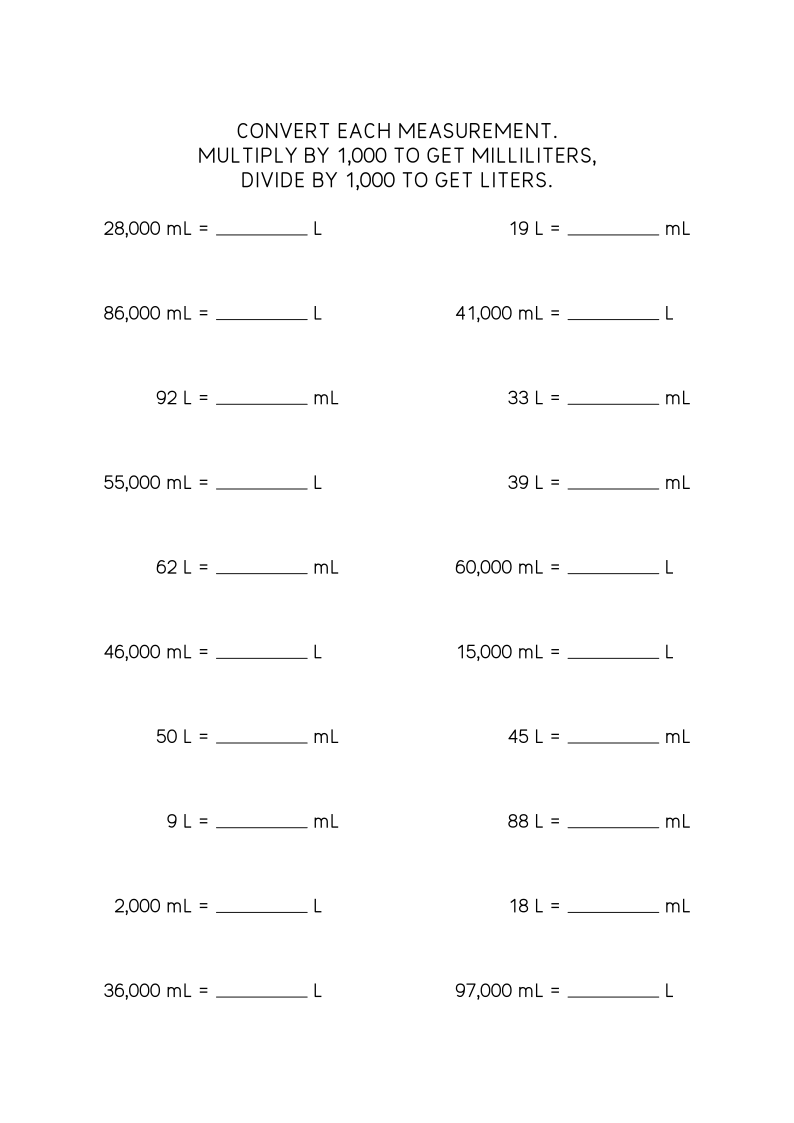
This browser is too old to make the page: please update it, or use another one. Here is an example page in the meantime.
The latest printable pages whose sheets were made with this generator, ready to download.


Frequently Asked Questions
How Many Cups Are in a Pint, a Quart and a Gallon?
A cup holds 8 fluid ounces, a pint 2 cups, a quart 2 pints and a gallon 4 quarts. Chained together, that makes a quart 4 cups or 32 fluid ounces, and a gallon 8 pints, 16 cups or 128 fluid ounces. Those are the ten facts the customary chart prints when All Units is chosen. Many classrooms draw them as the gallon figure: a big G holding four Qs, each Q holding two Ps, each P two Cs, which shows at a glance that 16 cups fill a gallon.
What Is the Difference Between Capacity and Volume?
Capacity is how much a container can hold, usually of a liquid; volume is how much space something takes up. The two meet in the metric system: a milliliter is exactly one cubic centimeter, and a liter is a cube 10 cm on each side, 1,000 cubic centimeters. Capacity units are the ones on recipes, bottles and measuring jugs, which is why these pages stay with milliliters to liters and fluid ounces to gallons rather than cubic units.
Is a US Pint the Same as a British Pint?
No. A US pint holds 16 US fluid ounces, about 473 mL, while a British imperial pint holds 20 imperial fluid ounces, about 568 mL, and the gallons differ in the same way, about 3.79 L against 4.55 L. The System setting says US Customary for that reason: every fact on these pages, such as 1 pt = 2 c or 1 gal = 128 fl oz, belongs to the US system. Length units, by contrast, are the same on both sides of the Atlantic.
Why Do European Bottles Say 75 cL or 33 cL?
Because centiliters, hundredths of a liter, are a common unit on drinks in Europe: a 75 cL bottle holds 750 mL, and a 33 cL can 330 mL. The metric pairs of the Units menu cover them all: Milliliters and Centiliters, Centiliters and Deciliters, Deciliters and Liters, Centiliters and Liters, and Milliliters and Liters. Since each of these units is ten times the one before, converting only shifts the digits: 1.5 L is 150 cL or 1,500 mL.
Can Liters Have Decimals on These Pages?
Yes, with Numbers set to Decimals, in metric units only. The larger unit then carries as many decimal places as its ratio allows: one for a ratio of 10, such as 4.7 dL = 47 cL, two for 100, such as 3.25 L = 325 cL, and up to three for Milliliters and Liters, such as 2.375 L = 2,375 mL, which keeps every answer in the small unit a whole number. Cups, pints and gallons go by 2, 4 and 8, not tenths, so customary pages use whole numbers or two units instead.
How Do You Convert 2 L 500 mL or 3 qt 1 pt?
Turn the liters or quarts into the small unit first, then add what remains: 2 L 500 mL is 2,000 + 500 = 2,500 mL, and 3 qt 1 pt is 3 × 2 + 1 = 7 pt. To go back up, divide; what does not make a whole large unit stays on a second answer line: 47 pt is 23 qt 1 pt, and 1,273 fl oz is 9 gal 121 fl oz. When only one small unit can be left over, as with pints in quarts or cups in pints, the larger number goes up to 32 so that a page still has enough different problems.
Which Is More, 3 Pints or 7 Cups?
7 cups, because 3 pints are 6 cups: the child writes < between them. Every comparison on these pages works that way, a capacity in the larger unit facing one in the smaller unit, and only a conversion settles it, since the two values are chosen within three steps of each other. The three signs share the page evenly, either side may hold the larger unit, and a capacity in two units always comes first.
Why Do Some Pages Write 1,000 and Others Not?
Only four pairs can reach 1,000: Centiliters and Liters, Milliliters and Liters, Fluid Ounces and Quarts, and Fluid Ounces and Gallons, as well as All Units; 32 gallons, for instance, are 4,096 fluid ounces. With those, the page offers Thousands separator, to write the comma, 4,096, or leave it out, 4096, as many countries write numbers. With the other pairs the numbers stay below 1,000 and the setting is not shown.
How Are the Lines of a Page Picked?
Metric pairs use 2 to 99 liters, deciliters or centiliters; pairs with a ratio of 2, 4 or 8 go up to 40; ratios of 16 and 32, such as cups in gallons, up to 36; and gallons in fluid ounces up to 32. Whatever the length of the page, ten, twenty or thirty lines, the pairs and the two directions get equal shares, no problem appears twice, and a problem never stands beside its own reverse. When the chart sits on top, the instructions shorten to the operation alone, for instance MULTIPLY BY 128; Line numbers can number every line.
When Do Children Learn Capacity Conversions?
In the US, third graders measure and estimate liquid volumes in liters, fourth graders learn the relative sizes of liters and milliliters and record conversions in tables, and fifth graders convert between units of one system, which many classes do with cups, pints, quarts and gallons. In England, Year 5 converts between liters and milliliters and meets approximate equivalences such as pints, and Year 6 converts with decimals up to three places.