
Read and Draw: Shapes to 20 (6 Printables)
Numbers from 8 to 20 to read and draw: a bigger challenge that rewards drawing in groups of five or ten.
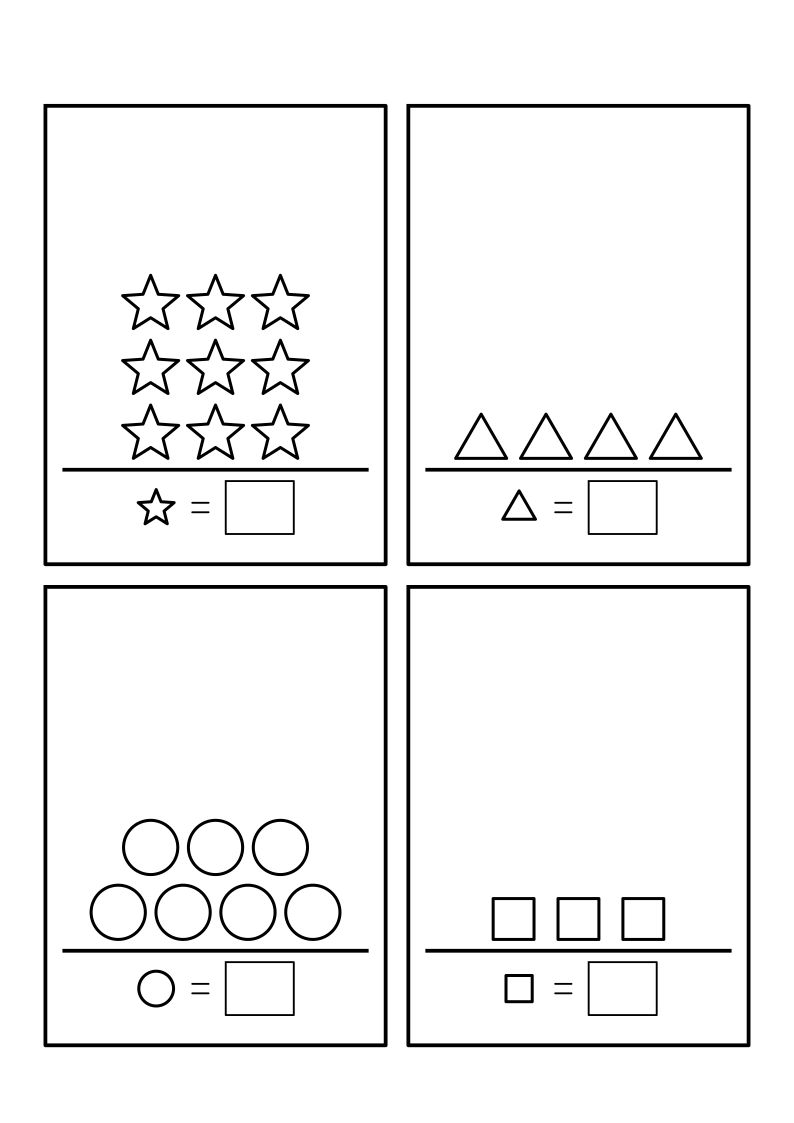
Make counting worksheets to print with simple shapes, circles, squares, triangles, stars and hearts, set above a shelf. In Count and write, the child counts the shapes over each shelf and writes their number in the box next to the shape to count; in Read and draw, the child reads the number under the shelf and draws that many shapes on it.
Choose the numbers, up to 5, up to 10 or up to 20, the exercise, the arrangement, the shapes lined up in a neat grid or tumbled into a heap as if they had dropped onto the shelf, and two, four or six exercises per page. Mixed shapes slips other shapes among those to count, and only the shape shown under the shelf counts; Borders frames each exercise.
The answer key writes each number in orange dots, or dots the outline of the shapes to draw.
Version 1. Last updated on Thu, 29 Oct 2026.
The latest printable pages whose sheets were made with this generator, ready to download.
Numbers from 8 to 20 to read and draw: a bigger challenge that rewards drawing in groups of five or ten.

Read a number from 3 to 10 and draw that amount of the shape shown, above the shelf, with two to six exercises per sheet.

The reverse of counting: read a number from 1 to 5 under the shelf and draw that many shapes in the space above it.

Counting past ten: 8 to 20 shapes per exercise, in rows or in a heap, with a box for the total under every shelf.
Counting worksheets with two, four or six exercises on a page, each a shelf holding shapes to count, or an empty shelf with a number of shapes to draw, for numbers up to 5, 10 or 20. The shapes stand in a grid or lie in a heap, all the same size on a page, and every sheet has its answer key.
Counting objects one by one and writing how many there are ties the spoken number to a quantity and to its digits, a step that comes before adding. Drawing a given number of shapes works the other way around, from the digit to the quantity. In a heap, the shapes lean every which way, so the child has to keep track of the ones already counted, for example by ticking each of them; a grid, in tidy rows, is easier to count.
Grid lines the shapes up in rows from the shelf upward, all standing straight, each row centered and the top row holding whatever is left. Gravity drops the shapes one after another, as if they fell onto the shelf: each one slides into the lowest spot within reach and rolls down until it settles, leaning at random, with a small gap from its neighbors, so the shapes pile up into a little mound. With the same seed, both arrangements use the same numbers and the same shapes.
Up to 5 suits children who are just starting to count, Up to 10 those who already count with confidence, and Up to 20 those who are learning the teen numbers. Every shape on a sheet is drawn at the same size, so the shapes look alike from one exercise to the next; on a crowded page, such as six exercises per page, the shapes of the whole sheet shrink together until they fit.
Mixed shapes adds a few other shapes to every Count and write exercise: the child counts only the shape shown under the shelf, beside the box, and leaves the rest aside, which trains careful looking as well as counting. Read and draw has no mixed shapes, since the child draws only the shape asked for.
For each exercise, the generator picks a number within the range of the level, never the same twice on a page while the range allows, and a shape, a different one for each exercise until all five have appeared. In a grid, the shapes stand in rows from the shelf up; in a heap, each shape is dropped near the middle and slides and rolls to rest against the shelf or the shapes already there. The heap is then centered over its shelf. Its seed sits in the page address, and a link to it gives back that very sheet.