
Angle Worksheet Generator
Make an angle worksheet to print, every angle drawn to the exact degree. Eight exercises: measure angles, draw them, name their type, and find the missing angle in a triangle, in a right angle, on a straight line, around a point or between two crossing lines.
For measuring and drawing, a protractor can be printed under each angle, ready to read. Three levels move from multiples of 10 degrees to any whole number.
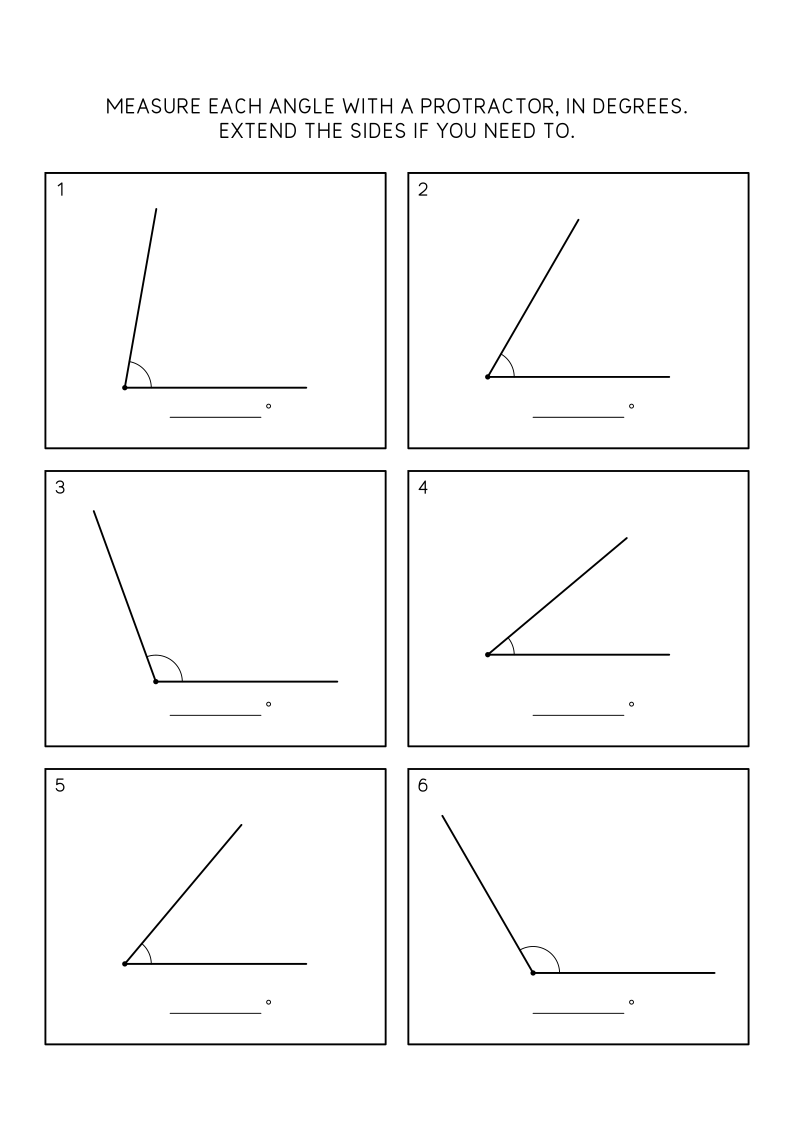
This browser is too old to make the page: please update it, or use another one. Here is an example page in the meantime.
The latest printable pages whose sheets were made with this generator, ready to download.


Frequently Asked Questions
What Can You Make With the Angle Worksheet Generator?
Eight kinds of pages. Measure Angles and Draw Angles train the protractor. Types of Angles asks for acute, right, obtuse, straight or reflex. Five exercises ask for a missing angle marked x: the third angle of a triangle, the rest of a right angle, of a straight line or of a full turn, and the angles made by two lines that cross. A page holds six exercises, twelve for the types.
Are the Angles Accurate Enough for a Protractor?
Yes. Each angle is drawn exactly, to the degree, with sides up to 48 millimeters long. Easy angles are multiples of 10 with one side lying flat; Medium angles, multiples of 5 turned any way; Hard angles, any whole number of degrees from 15 to 345, reflex angles included. Angles within 15 degrees of a straight line are left out, since they are hard to read.
What Does the Printed Protractor Do?
Tick Printed protractor, with Measure Angles or Draw Angles, and a half-circle protractor is drawn under each angle, marked degree by degree with its two scales, one from each end. One side of the angle lies on its base line, so the child reads the other side on the scale that starts at 0 under the first. It teaches which scale to use before a real protractor comes out.
How Does Draw Angles Work?
Each frame gives the vertex, as a dot, one side already drawn, and the size to reach, such as 65 degrees. The child places the protractor on the dot, marks the size and draws the second side. The answer key shows that side in orange dashes. Sizes stay between 15 and 165 degrees, so the angle always opens above the side given.
Which Rules Do the Missing Angle Exercises Use?
One rule per exercise, printed on top of the sheet. The angles of a triangle add up to 180 degrees; so do angles on a straight line; angles in a right angle add up to 90, and angles around a point to 360. Two crossing lines make equal angles opposite each other, and from Medium up the unknown angle may also be the neighbor, which completes 180.
What Changes Between the Levels?
The size of the steps and the number of angles. Easy uses multiples of 10 and the fewest angles: two on a line, three around a point. Medium uses multiples of 5 and turns the figures. Hard uses any whole number, three angles on a tilted line, up to five around a point, and reflex angles to measure and to name. In a triangle, x is never the right angle, which its square would give away.
How Does the Angle Worksheet Generator Work?
- Open Exercise and take one of the eight.
- Pick the level, the lettering, the printed protractor when it shows, and the instruction lines.
- Press New for other angles and Print when the page suits you, then again with Show the solution for the answers.
The worksheet is drawn in your browser the moment you ask, free and without an account.