
Number Tracing Worksheet Generator
Make printable number tracing worksheets, sometimes called number writing practice: one digit from 0 to 9 repeated on every row, or ten numbers that follow each other, one to a row. A row opens on the digit or the number in solid black, the model, followed by copies in thin dashes that the child goes over with a pencil, between three guide lines.
Pick One digit, then the digit and its size, large, medium or small, for digits 20, 15 or 11 mm tall on seven, nine or thirteen rows; or pick Numbers in order: 0 to 9, 1 to 10, 11 to 20, or counting by 2s to 20, by 5s to 50 or by 10s to 100, always on ten rows of 14 mm digits. Dashed Copies sets how far the dashes go along each row: all the way, halfway, one copy or none, leaving the rest of the row for writing without help. Font switches between Pebble, with round, even strokes, and Granite, with the digits of a printed book.
A name line and a date line can be added at the top. Since the model leads every row, the sheet needs no answer key.
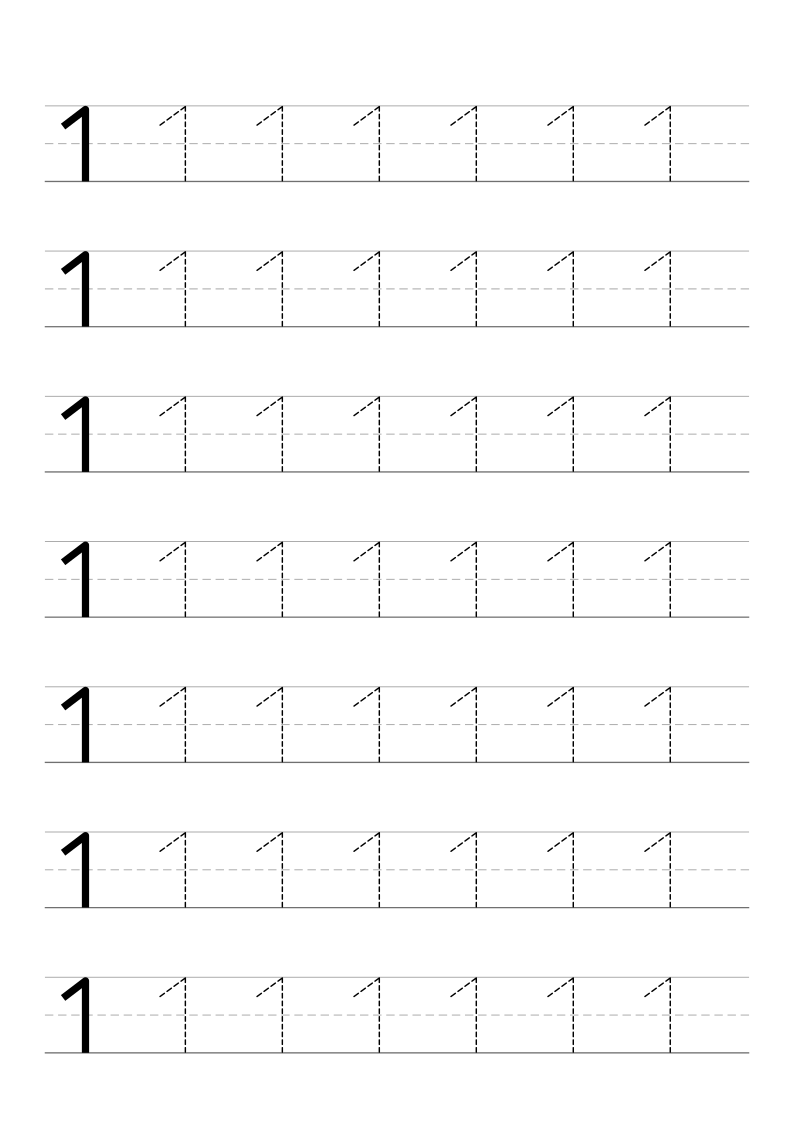
This browser is too old to make the page: please update it, or use another one. Here is an example page in the meantime.
The latest printable pages whose sheets were made with this generator, ready to download.


Frequently Asked Questions
What Can You Make With the Number Tracing Worksheet Generator?
Writing sheets for the digits and the first numbers: a single digit traced over and over, at one of three sizes, or a run of ten numbers in order, from the digits 0 to 9 to the tens from 10 to 100. Every row shows how the number looks in solid black, then gives dashed copies to follow, from a full row of them down to none at all.
Why Practice Tracing Numbers?
Going over a dashed digit lets a child follow its whole path, its curves and its corners, before writing it alone: the loop of the 6 and the 9, the two bowls of the 3, the diagonal of the 7. Repeating one digit fixes its shape; writing ten numbers in order joins writing to counting, and the two-digit numbers show how the tens digit comes first.
One Digit or Numbers in Order: What Is the Difference?
One digit repeats the same digit on every row of the page, seven, nine or thirteen rows depending on the size: the sheet for learning one shape well. Numbers in order gives each of its ten rows a different number of the sequence, top to bottom, at a single size of 14 mm, so that numbers up to 100 still leave room for their copies.
Which Sequence of Numbers Should I Choose?
0 to 9 goes through every digit once, a review after learning them one by one. 1 to 10 follows counting, ending on the first two-digit number, and 11 to 20 practices the teens, each written with a 1 before its second digit, and then 20. Counting by 2s runs from 2 to 20, by 5s from 5 to 50 and by 10s from 10 to 100: skip counting, written down.
How Many Dashed Copies Does a Row Get?
With Whole line, copies follow the model to the right margin: six for a large digit, five for a two-digit number of a sequence, three for 100. Half a line stops them at the middle of the page and leaves the other half empty for writing freehand, One gives a single copy, and None keeps only the model, for a child ready to write each number alone on the guide lines.
What Do the Three Guide Lines Show?
Every digit is as tall as the space between the top line and the bottom line, which is a darker gray, so the child learns to make all the digits the same height. The dashed line in the middle marks half the height, where the two loops of an 8 meet and where the middle of a 3 turns back.
Which Digit Size Should I Choose?
Large digits, 20 mm on seven rows, give a young hand plenty of room for its first tries. Medium, 15 mm on nine rows, and Small, 11 mm on thirteen, bring the digits closer to the size of everyday writing, for children who already hold the pencil steadily. A sequence of numbers always uses 14 mm, between the two.
What Age Is Number Tracing For?
Tracing digits is a preschool and kindergarten activity. The US Common Core expects kindergarten children to write numbers from 0 to 20 and to count to 100 by ones and by tens, and the sequences from 0 to 20 and the count by 10s follow these goals. Large digits with full rows of copies suit beginners; small digits and fewer copies suit children who already write their numbers.
How Does the Number Tracing Worksheet Generator Work?
The digits come from the site's own fonts, drawn as vector shapes, so the page prints sharply at any size. Its rows are spread evenly from the name line to the bottom margin, and each copy starts after the width of the number and a gap of half its height. Each dashed copy follows the stroke of the solid digit and reaches the same lines. A sheet depends only on its settings: the link to the page draws it again exactly.