
Morse Code Worksheet Generator
Make Morse code worksheets to print, in the international code of 26 letters and ten digits. Exercise sets the direction: Decode a Message prints the dots and dashes of each letter above a line where the child writes the letter, and Write in Morse Code prints the letters, each above a line where the child draws its code. Every dash is three dots long, with one dot of space between two signs, as in the code itself.
Messages chooses what to send: Short Words, twelve words of three or four letters; Long Words, eight words of five to seven; or Secret Messages, whole sentences such as MEET ME AT THE OAK TREE, some with a number in digits. Code chart keeps the whole alphabet in Morse in a box at the top, with the digits alongside the secret messages, or removes it with None. Line numbers, Show the instructions and Font, Pebble or Granite, finish the page.
Show the solution writes each decoded letter in orange, or draws each code in orange outlines, and New picks other words.
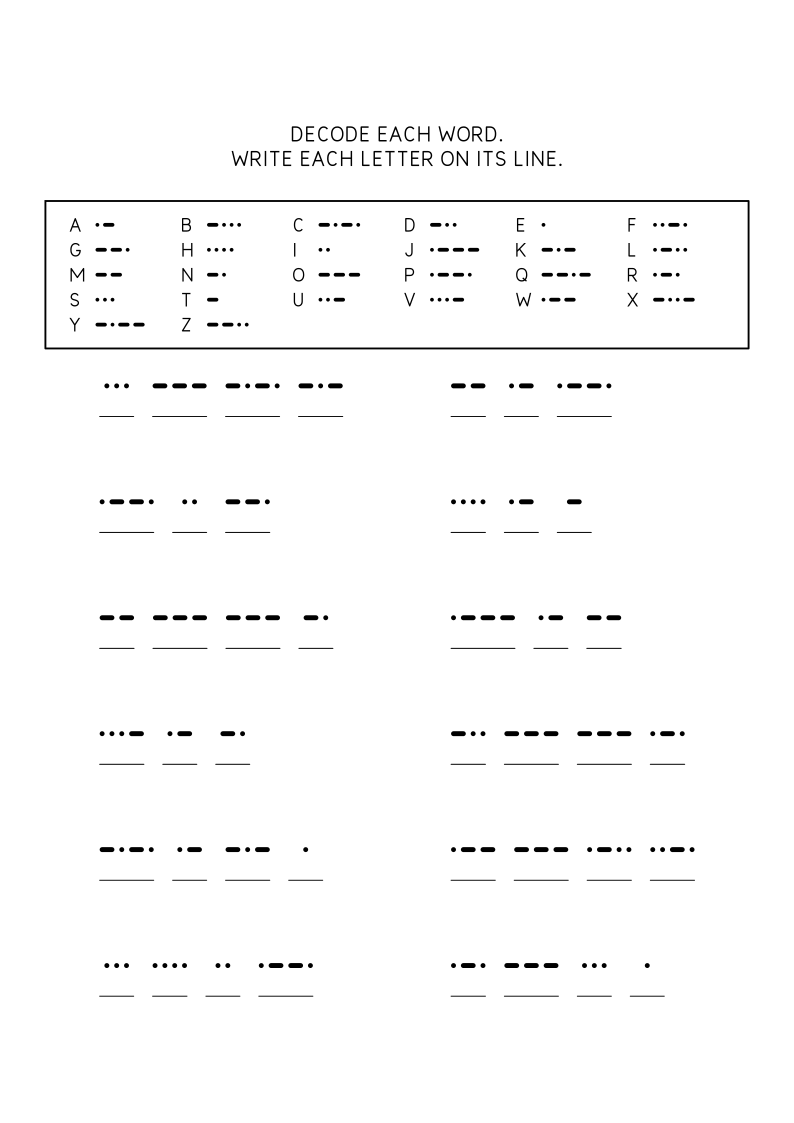
This browser is too old to make the page: please update it, or use another one. Here is an example page in the meantime.
The latest printable pages whose sheets were made with this generator, ready to download.


Frequently Asked Questions
How Do You Read Morse Code?
Take one group of signs at a time, since each group is one letter: count its dots and dashes, find the same pattern in the chart, then write that letter on the line below. E is a single dot, T a single dash, S three dots and O three dashes, so ··· −−− ··· spells SOS. On Decode a Message pages every letter has its own line, set a little apart from the next, and words are separated by a wider gap, so the child never has to guess where a letter or a word ends. A decoded word that makes no sense points to a group that was misread.
How Do You Write a Word in Morse Code?
Look each letter up in the chart and copy its signs onto the line under it: a dot is a small round mark, a dash a short line about three times as long, with a small gap between two signs. The lines of Write in Morse Code pages are sized to the code they will hold, at least 12 mm wide, so a long letter such as Y, −·−−, has more room than E. The instructions say to draw the dots and dashes under each letter, or under each letter or digit on Secret Messages pages, where numbers have to be coded too.
Why Is a Dash Three Times as Long as a Dot?
Morse code is a code of time. The dot is the unit; a dash lasts three units; the silence between two signs of a letter lasts one unit, between two letters three, and between two words seven. Sent by sound or light, those lengths are what tell a listener where letters and words end. The pages draw the same proportions: a dot is a round 1.3 mm wide, a dash is 3.9 mm long with rounded ends, and 1.3 mm separates two signs, while each letter keeps its own line and each word stands 10 mm from the next.
Which Morse Code Letters Are Easiest to Learn?
The most frequent letters in English got the shortest codes: E is ·, T is −, then I ··, A ·−, N −· and M −−, S ··· and O −−−. Learning those few already covers words like SEA, NOTE or MOON. Some letters are a reflection of each other, their signs in reverse order: A and N, D and U, G and W, B and V, F and L, Q and Y, so learning one gives the other. Short Words pages are a good start, since every word has three or four letters and the whole list uses each letter of the alphabet.
How Are Numbers Written in Morse Code?
Every digit has exactly five signs, which makes them easy to tell from letters. From 1 to 5, the digit gives the number of dots, followed by dashes: 1 is ·−−−−, 3 is ···−− and 5 is ·····. From 6 to 0 the pattern flips, dashes first: 6 is −····, 8 is −−−·· and 0 is −−−−−. Digits appear only in Secret Messages, as in BRING 3 RED APPLES, and only then does the chart at the top list them, after the letters, from 1 to 9 and then 0.
What Is the Difference Between Short Words, Long Words and Secret Messages?
The length of what is sent. Short Words gives a dozen words of three or four letters, such as BIRD or ANT, in two columns of six. Long Words gives eight words of five to seven letters, such as ANCHOR or BASKET, in one column. Secret Messages gives sentences of four to six words, four to decode or three to write, each running over up to three rows, and some include a number. No word or message comes twice on a page, a word is never split between two rows, and Line numbers can put 1., 2., 3. in front of each one.
When Should the Code Chart Be Taken Off?
Keep it for the first pages: nobody is expected to know the code by heart, and looking letters up is itself good practice. The chart sits in a framed box above the messages, in six columns, each letter followed by its code in small signs, and the ten digits join it on Secret Messages pages. Set Code chart to None once the child knows the common letters, to test memory, or to make a game where one shared chart lies on the table and the fastest decoder wins.
How Do You Spot a Wrong Dot or Dash?
Decoding checks itself to a point: a misread group usually turns a word into nonsense. For a full check, Show the solution prints the same page with the answers in orange: on decoding pages each letter written in dashes on its line, on writing pages the dots and dashes of every letter drawn as outlines, at the size the child should draw them, so a sign too long or one missing shows at once. The seed in the address keeps the words, so the answer copy always matches the page the child worked on.
Who Invented Morse Code?
It is named after Samuel Morse, who built an electric telegraph with Alfred Vail in the 1830s and 1840s; their line from Washington to Baltimore carried the message WHAT HATH GOD WROUGHT in 1844. The international version used on these pages, with its slightly different letters and its five-sign digits, became the standard in the 1860s. Ships relied on it for distress calls until 1999, and radio amateurs still send it today, which is why SOS remains the best-known pattern of dots and dashes.
What Do Children Learn With Morse Code?
Decoding is slow, careful reading: matching patterns, spelling a word letter by letter and checking that it makes sense. Writing in code trains attention to detail, since one dot too many changes the letter. Morse code also shows how any message can be carried by just two signals, an idea behind every digital code, and it fits lessons on inventions, communication and history. Secret messages such as LOOK BEHIND THE BLUE DOOR make it easy to turn a page into a treasure hunt or a spy game.