
9x9 Hashi – 4 per Page (24 Printables)
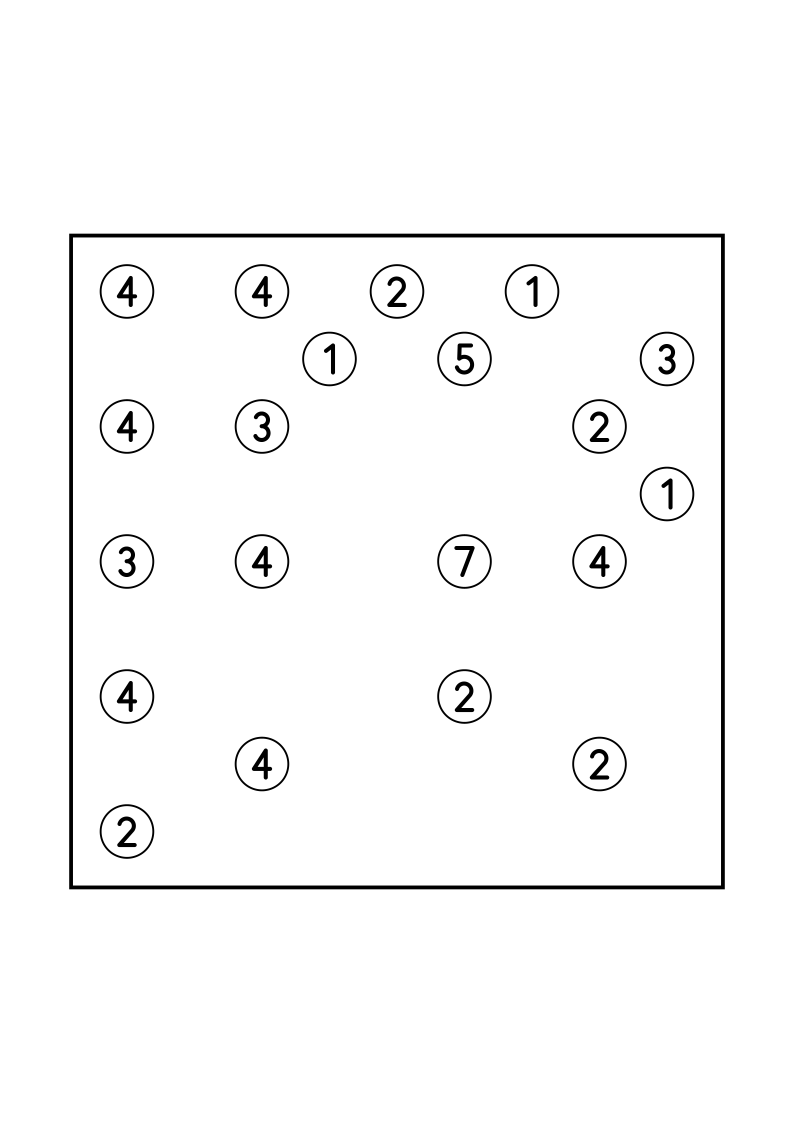
Four framed 9x9 hashi puzzles per sheet, in three levels: the classic hashi size as a compact series, every sheet also in the book.
Make a Hashi to print, the Japanese bridges puzzle also called hashiwokakero, or simply Bridges: link the numbered islands with straight bridges, across or down, one or two between two islands, never crossing another bridge. Each number tells how many bridges its island takes, and in the end every island is linked to all the others. Four sizes, from 7x7 to 13x13, and three levels.
Pick one of the four sizes and one of the three levels; the 7x7 and 9x9 grids also print four to a page, and Guides can mark the cells under the islands in light gray, with lines or dots. Easy is solved by counting the bridges each island needs; Medium also asks you to keep groups of islands from closing themselves off; Hard asks you to try a bridge in your head and see where it leads. Each grid has one solution, found without guessing.
Press New for another grid; Show the solution draws every bridge in orange dots, which stand out from the grid even in black and white.
Version 1. Last updated on Thu, 29 Oct 2026.
The latest printable pages whose sheets were made with this generator, ready to download.
Four framed 9x9 hashi puzzles per sheet, in three levels: the classic hashi size as a compact series, every sheet also in the book.

Every sheet holds four small 7x7 hashi puzzles in separate frames, Easy, Medium or Hard: bridges puzzles for classrooms and families, with a book of the set.

The largest hashi, 13x13, one puzzle per page: about forty islands, some seven cells apart, at three levels, for experienced solvers who want a wide network.
Bridge puzzles in four sizes, from a quick 7x7 grid with about a dozen islands to a 13x13 grid with about forty, each at three levels. The two smallest sizes also fit four grids on one sheet, Guides can add light gray lines or dots under the islands, and Show the solution draws the answer key of every grid.
Hashi, short for hashiwokakero, Japanese for “build bridges”, and sold in English puzzle books as Bridges, starts with numbered circles, the islands. Connect them with straight lines, the bridges, running across or down between two islands with nothing in between. Two islands share at most two bridges, bridges never cross each other, and each island ends up with exactly as many bridges as its number. When every island has its bridges, they must all form one connected network, so that you can travel from any island to any other. Hashi trains counting, planning and spatial thinking.
Begin with the islands whose number leaves no choice. An island in a corner with a 4 has only two neighbors, so it needs a double bridge to each; a 6 with three neighbors, or an 8 with four, works the same way. An island whose number is one less than twice its neighbors, like a 3 with two neighbors, takes at least one bridge to each of them. Then watch for closed groups: two 1s joined together, or two 2s joined by a double bridge, would leave a small group cut off from the rest, so those bridges are impossible.
The size sets the number of islands: about 12 on the 7x7 grid, 20 on the 9x9, 30 on the 11x11 and 40 on the 13x13. The level sets the reasoning. Easy needs only counting: what each island still needs, and what its neighbors can still give. Medium adds the connection rule, so that no group of islands closes itself off. Hard sometimes asks you to imagine a bridge, follow its consequences, and rule it out when they lead to a contradiction. A 9x9 grid at Easy or Medium makes a good first puzzle. If islands are hard to line up by eye, Lines draws the cells in light gray and Dots marks the middle of every empty cell, where the bridges run; neither changes the puzzle.
The generator grows a network of islands from a single starting island, laying straight bridges of random length, single or double, that never cross, until about a quarter of the cells hold an island and every edge of the grid has one. The number on each island is its count of bridges, so the network is a solution. A solver that never guesses then works through the puzzle with the reasoning of the chosen level; wherever it gets stuck, the generator changes a bridge there, which changes the numbers of its islands, and tries again. A grid the solver finishes has only one solution, and it is kept only if the reasoning of the easier level could not finish it. Each sheet keeps its seed in the page address, so reloading or sharing the link shows the same puzzle again.