
Binairo Generator
Make Binairo puzzles to print, the logic game of 0 and 1 also sold as Takuzu, Binero or binary puzzle. A grid starts with a few digits, and three rules fill the rest: never more than two equal digits side by side, as many 0 as 1 in each row and each column, and no two rows or two columns the same.
Choose a grid from 6x6 to 12x12 and one of three levels, one grid per page or four. Every puzzle has exactly one solution and is solved by logic alone, never by luck; the solution prints in dashed digits.
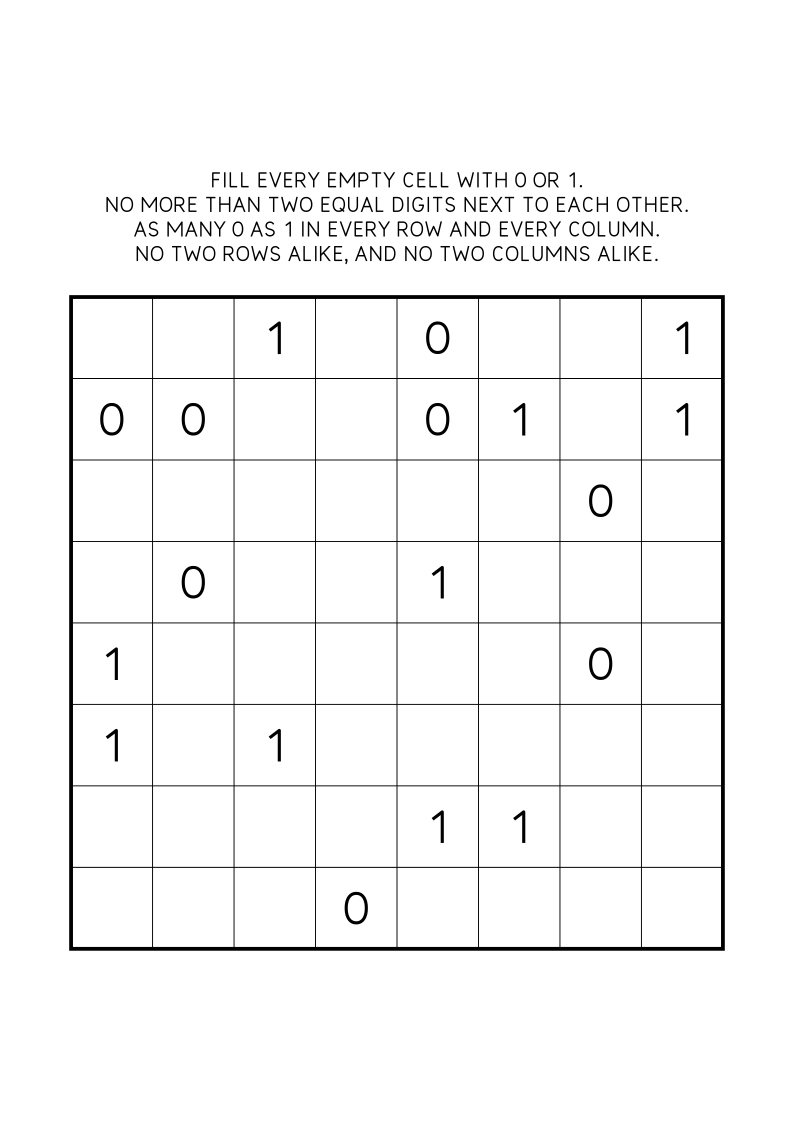
This browser is too old to make the page: please update it, or use another one. Here is an example page in the meantime.
The latest printable pages whose sheets were made with this generator, ready to download.


Frequently Asked Questions
What Can You Make With the Binairo Generator?
Binairo grids of 6x6, 8x8, 10x10 or 12x12 cells, at an Easy, Medium or Hard level, one large grid on the page or four smaller ones. Pressing New draws another grid, and each one is built so that it has a single solution.
What Are the Rules of Binairo?
- Each cell holds a 0 or a 1.
- No more than two equal digits may touch in a row or in a column: 00 is allowed, 000 is not.
- Every row and every column holds as many 0 as 1: three of each on a 6x6 grid, six of each on a 12x12.
- All rows are different from one another, and so are all columns.
Is Binairo the Same as Takuzu?
Yes. Binairo, Takuzu, Binero and binary puzzle are names that different publishers give to the same game. You may also meet it drawn with black and white circles, or with X and O instead of 0 and 1. The rules do not change with the name.
How Do You Start a Binairo Grid?
Look first for two equal digits side by side: the cells at both ends of the pair take the other digit. Then look for two equal digits with one empty cell between them: that cell takes the other digit too. After that, count: a row that already has its full share of 0 can only receive 1 in its empty cells.
What Changes Between Easy, Medium and Hard?
The level is the finest reasoning a grid needs, not its size. An Easy grid can be finished with the pairs, the gaps and the counting. A Medium grid needs one more idea: when a row has only one 0 left to place, some cells cannot take it, because the 1 written everywhere else would then stand three in a line. A Hard grid asks for more again: comparing an almost finished row with a complete one, since two rows may not match, or testing a digit in a cell and seeing that it leads to a contradiction.
Which Grid Size Should I Choose?
A 6x6 grid has 36 cells: the place to learn the rules, for children and beginners. An 8x8 grid has 64, a 10x10 has 100 and a 12x12 has 144, the same reasoning on a larger board. With four grids on a page the cells get smaller: about 8 mm wide on a 12x12 grid, against 14 mm when the grid has the page to itself.
Does Every Grid Have Only One Solution?
Yes. The generator starts from a complete grid that obeys the three rules, then removes digits one at a time for as long as the reasoning of the chosen level still rebuilds the whole grid. What is left can be solved without guessing, so it cannot have two solutions; and every digit that remains is needed, since taking any one of them away would leave the grid unsolvable at its level.
How Does the Solution Print?
Check Show the solution to print the same grid with each missing digit written in orange dashes. The digits given at the start stay solid and black, so the two cannot be confused, even when the printer has no color.
How Does the Binairo Generator Work?
Each grid grows from a seed, a number that its web address carries: open that address again and the very same grid returns, which makes a puzzle easy to share or to reprint. The rules are printed above the grid; uncheck Show the instructions to leave them out.