
9x9 Kropki – 4 per Page (24 Printables)
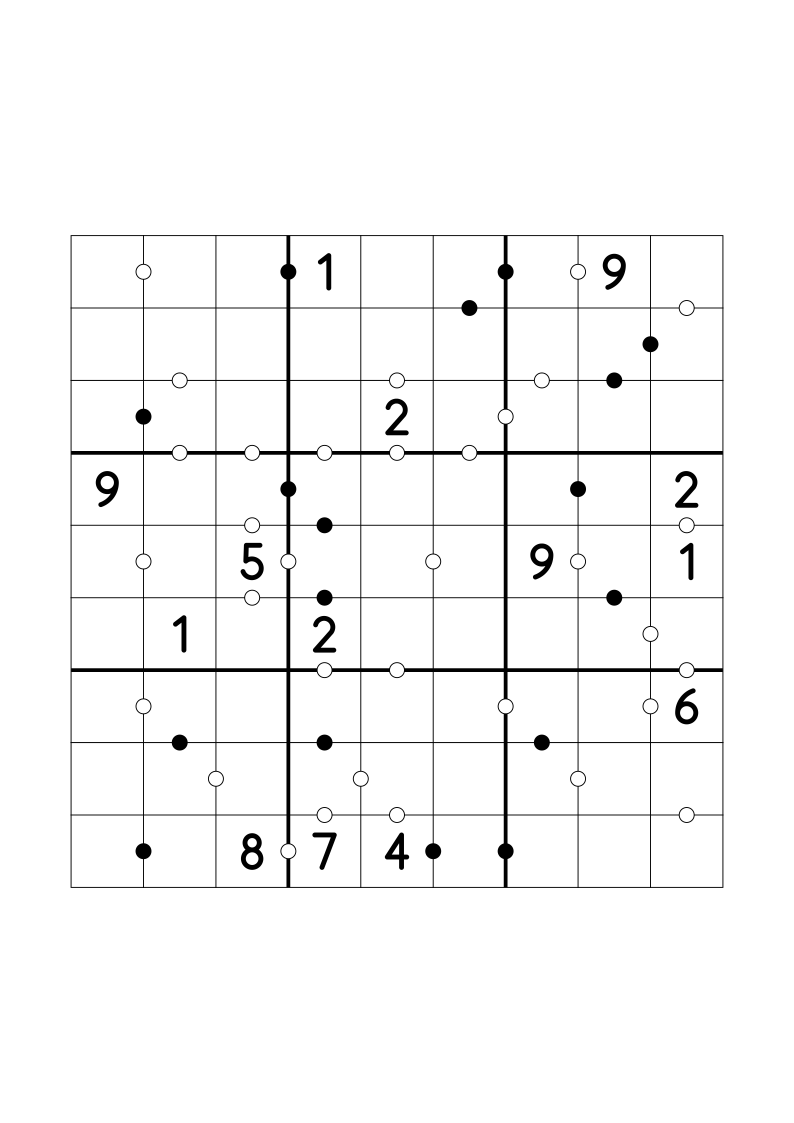
Four 9x9 Kropki grids on one sheet, compact but complete, at a single level per page: a dense set of dot sudokus for regular solvers.
Make a Kropki to print, the sudoku with dots, also known as Kropki Sudoku (kropki is Polish for dots): fill the grid so that every row, column and box holds each digit once. A white dot between two cells says that their digits are consecutive, like 4 and 5; a black dot says that one digit is twice the other, like 3 and 6; between 1 and 2, either color can appear. All the dots are drawn, so two neighboring cells without a dot hold digits that are neither consecutive nor double.
Pick the grid, 4x4, 6x6 or 9x9, the level and the border: thin, with only the box lines in bold, or bold, like a classic sudoku, then one grid per page or four. Easy gives the most digits, Medium half as many, and Hard as few as the dots allow, usually none on the 4x4 and 6x6 grids.
New brings another grid; Show the solution adds the hidden digits as orange dots.
Version 1. Last updated on Thu, 29 Oct 2026.
The latest printable pages whose sheets were made with this generator, ready to download.
Four 9x9 Kropki grids on one sheet, compact but complete, at a single level per page: a dense set of dot sudokus for regular solvers.

The classic 9x9 Kropki, one grid per page, with boxes of three by three and four doubles to track: 1 and 2, 2 and 4, 3 and 6, 4 and 8.

Four 6x6 Kropki grids per page at the same level, each with its own dots: a compact set for practice at home or in class.

Mid-size Kropki on a 6x6 grid with boxes two rows tall and three columns wide, one per page, where doubles such as 3 and 6 start to matter.
Dot sudoku puzzles on small, medium and full-size grids, 4x4, 6x6 and 9x9, each at three levels, one grid or four per sheet, framed by a thin border or a bold one. Every grid comes with its answer key, shown by Show the solution.
Kropki, a Polish word meaning dots, is a sudoku with dots set on the lines between neighboring cells, and is also sold as Kropki Sudoku. As in any sudoku, every row, column and box takes each digit once; the digits stop at 4, 6 or 9, the side of the grid. A white dot joins two cells whose digits differ by one, such as 7 and 8; a black dot joins two cells where one digit is double the other, such as 2 and 4. Since every dot is printed, a pair of neighbors with no dot between them rules out both relations, and that absence is a clue as well.
The digits 1 and 2 follow each other, and 2 is also twice 1, so both rules fit this pair: the generator gives it a white or a black dot at random. While solving, remember that a white dot may hide 1 and 2 as well as 5 and 6, and a black dot may hide 1 and 2 as well as 3 and 6 or 4 and 8.
The 4x4 grid, using only 1, 2, 3 and 4 in boxes of two by two cells, is the best place to learn how the dots work. The 6x6 grid splits into boxes three cells wide and two cells tall, and brings new black pairs such as 3 and 6. The 9x9 grid uses every possible pair, from 1 and 2 to 8 and 9, and 4 and 8. The level sets the number of given digits: Easy shows the most, Medium half as many, and Hard leaves the grid almost bare, so that the dots carry the puzzle. A first Kropki works well as an Easy 4x4 grid; move to a bigger grid or a harder level once the dots feel familiar.
With the thin border, the grid looks like the # of a pencil game: only the lines between the boxes are bold, and the outer edge is as fine as the lines of the cells. The bold border closes the grid with a thick frame, like a classic sudoku. The puzzle is the same either way.
The generator first fills a complete grid at random, which becomes the solution, and draws every dot that the grid calls for: white between consecutive digits, black between a digit and its double, and a random color between 1 and 2. Then it erases digits in a shuffled order, and each erasure stays only when a guess-free solver still reaches the full grid from the remaining digits and the dots. It stops once the given digits of the level are reached, or, on Hard, when no further digit can go. A grid the solver finishes has one solution only. Reloading the page, or sharing its link, shows the same grid again, thanks to the seed kept in its address; a page of four always holds four different grids.