
Hitori Generator
Make Hitori puzzles to print, the Japanese shading puzzle whose full name, Hitori ni shite kure, means leave me alone; some collections call it Singles. The grid arrives full of numbers, and the job is to black out some of them until no number is left twice in any row or column. Two more rules keep it honest: shaded cells never share a side, and the cells left white must all hold together in one piece.
Pick a grid from 5x5 to 9x9 and one of three levels, with one grid on the sheet or four. Each puzzle has a single solution, reached by logic, and the solution sheet marks every cell to shade with a dashed cross.
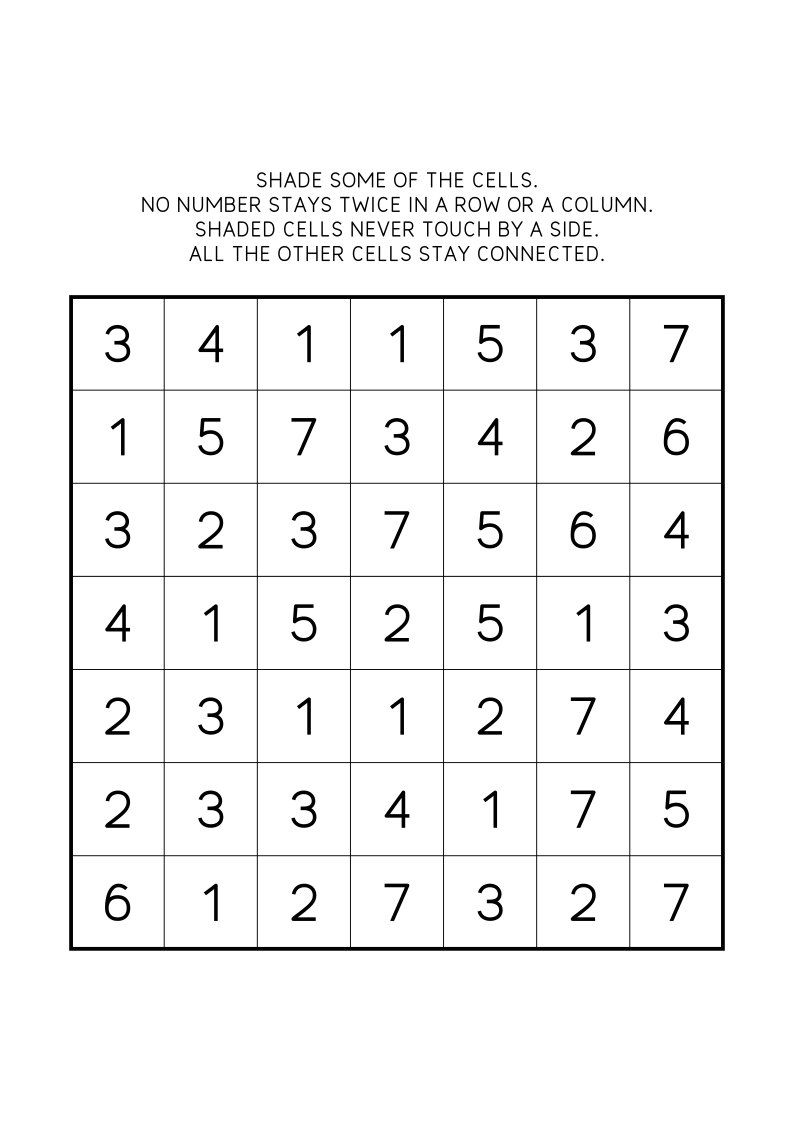
This browser is too old to make the page: please update it, or use another one. Here is an example page in the meantime.
The latest printable pages whose sheets were made with this generator, ready to download.


Frequently Asked Questions
What Can You Make With the Hitori Generator?
Hitori grids of 5x5, 6x6, 7x7, 8x8 or 9x9 cells, in three levels named Easy, Medium and Hard, printed one to a sheet or four to a sheet. New draws a different grid each time, and none of them can be solved in two ways.
What Are the Rules of Hitori?
- Shade cells so that no number is left more than once among the white cells of a row or of a column.
- Two shaded cells may meet at a corner, never along a side.
- The white cells form a single area: from any white cell you can walk to any other, moving up, down, left or right, without stepping on a shaded one.
Is Hitori the Same as Singles?
Yes. Hitori is the short form of Hitori ni shite kure, Japanese for leave me alone, the name the publisher Nikoli gave the puzzle: every number wants to be alone in its row and its column. Singles is the same game under an English name, with the same three rules.
How Do You Start a Hitori Grid?
Hunt for a number sandwiched between two equal numbers, like 4 7 4: the 7 has to stay white, because shading it would leave both 4s white, twice in the same line. Then look for two equal numbers that touch: one of the pair will be shaded and the other kept, so any third copy of that number in the same line can be shaded at once. Each time you shade a cell, circle its four neighbors: they are safe.
How Do the Three Levels Differ?
The level names the hardest idea a grid asks for. In an Easy grid, every cell to shade can be found by reading the numbers: the sandwiches, the touching pairs, the neighbors of a shaded cell, and the copies of a number you already know is white. A Medium grid also makes you watch the white area: a cell must stay white when shading it would cut some cells off from the rest. A Hard grid needs a what-if step somewhere: suppose a cell is shaded, or white, follow the consequences, and when they break a rule, the cell is the other color.
Which Grid Size Should I Choose?
A 5x5 grid has 25 cells, of which about 7 end up shaded: a good first Hitori. A 9x9 grid has 81 cells and about 23 to shade. Printed alone, a grid is about 17 cm wide, so the numbers of a 9x9 sit in cells of 19 mm; four grids on a sheet bring those cells down to 11 mm.
Can a Hitori Grid Have Two Solutions?
No. The generator first decides which cells are shaded, in a pattern that obeys the rules and to which no further cell could be added. It then fills the white cells so that no number repeats in a line, and gives each shaded cell the number of a white cell from its row or its column. The grid is kept only if the reasoning of its level finds every shaded cell without guessing, which leaves room for one solution only.
How Does the Solution Print?
Check Show the solution and each cell to shade is crossed out with a dashed orange X. The number under the cross stays readable, and the dots still stand out on a printer that has only black ink.
How Does the Hitori Generator Work?
A grid is drawn from its seed, a number carried by the address of its page along with the size and the level: keep or share that address and it opens the very same puzzle. The sheet starts with what to do and the three rules; clear the Show the instructions box to print it without them.