
Checklist Generator
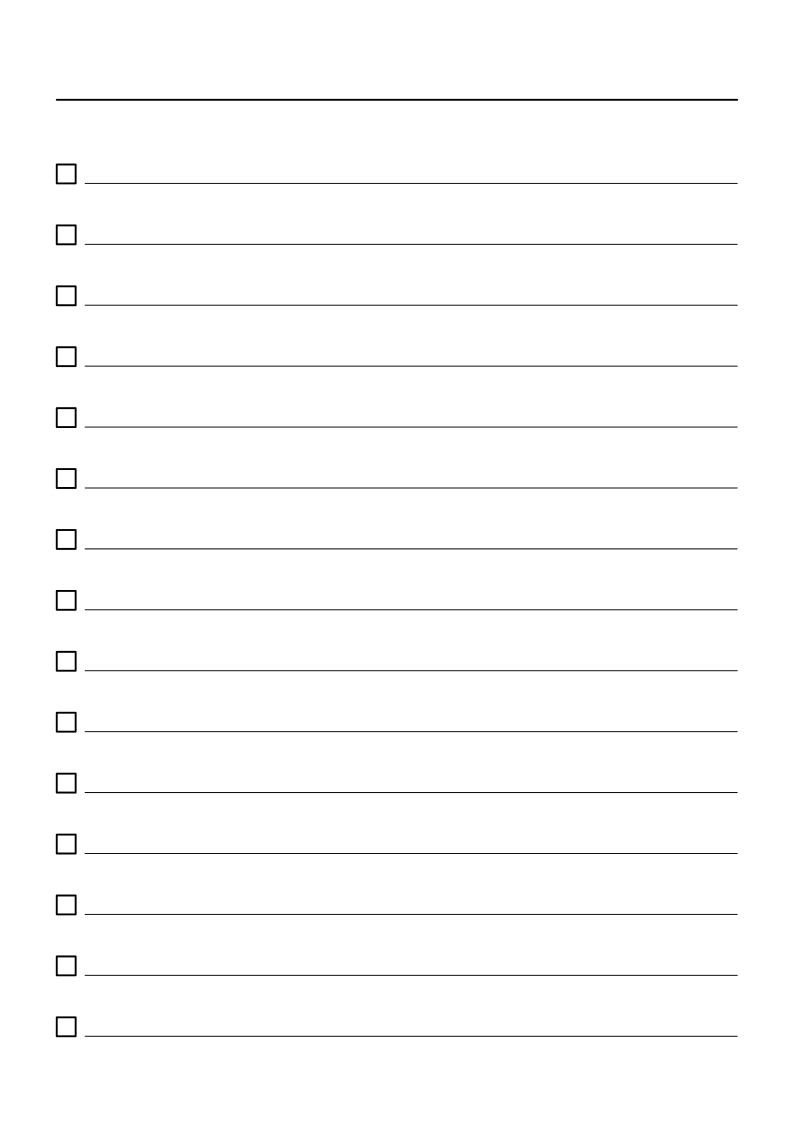
Make a checklist to print and fill in with a pen: a page of lines to write on, each one behind a box to tick once the job is done. Use it as a to-do list for the day, the steps of a project, a packing or shopping list, or a morning or bedtime routine for a child.
Choose how many lines a column holds, from 10 widely spaced to 25 close together, one column across the sheet or two side by side, the shape of the boxes (square, round, heart, star, or none at all), and the lines to write on: solid, dotted, dashed, or left out. Add numbers in front of the lines, a line at the top to name the list, and one at the bottom for a note or a signature.
This browser is too old to make the page: please update it, or use another one. Here is an example page in the meantime.
The latest printable pages whose sheets were made with this generator, ready to download.

Frequently Asked Questions
What Can You Make With the Checklist Generator?
Blank lists to fill in by hand: 10, 12, 15, 20, 24 or 25 lines per column, in one column or two, so a sheet holds from 10 to 50 lines. Every line can begin with a box to tick, square, round, heart-shaped or star-shaped, and can carry its number. Above the list, a longer and thicker line waits for a title; another one can close the page at the bottom.
What Is a Printable Checklist For?
For anything you want to see done and ticked: the tasks of a day or a week, the stages of a project, what to pack for a trip, groceries, chores shared around the house. Children use the same page as a routine chart, one step per line, such as getting dressed, brushing teeth and packing the school bag. Unlike a list on a phone, a sheet stays in sight, on the fridge or on a desk.
How Many Lines Should I Choose?
The lines of a column share the height of the page, so fewer lines means more room for each. With the line at the top shown, 10 lines sit about 24 mm apart, enough for a child's large handwriting or a small drawing next to each step; 12 lines, about 20 mm; 15 lines, about 16 mm; 20 lines, about 12 mm; 24 lines, about 10 mm; and 25 lines a little under 10 mm, for adult handwriting and long lists.
One Column or Two?
One column gives each line the full width of the sheet, about 17 cm of writing after the box, enough for a whole sentence. Two columns give each line a little under half of that and double the count, up to 50 lines on a page: the better choice for short entries such as a grocery list, a packing list or a reading list.
Which Box Shape Should I Choose?
All four have the same size, 5 mm across on most pages, and the same stroke, so the choice is one of taste. The square is the classic tick box of forms and to-do lists. The circle looks like a bullet point, and young children often like to color it in rather than tick it. Hearts and stars turn a chore chart into a reward chart, one shape to fill per job done. None removes the boxes and leaves plain lines, numbered if you wish.
What Do Numbered Lines Add?
A number before each box, counting from 1 down the column; with two columns, the second one carries on where the first stopped, so a page of two columns of 25 lines runs from 1 to 50. Numbers help when the order matters, as in a recipe or a set of instructions, and they show at a glance how long the list is. They are written in the font chosen for the sheet, Pebble or Granite.
Solid, Dotted or Dashed Lines?
Solid lines are the usual ruled page. Dotted lines stay light under the handwriting, and dashed lines give young writers a guide they can still see once the words are there. None keeps only the boxes, with white space beside each one for a drawing or a sticker; the page then always keeps its line at the top.
What Are the Top and Bottom Lines For?
The line at the top runs across the sheet, with space above it to write what the list is about: a date, a trip, a project, a child's name. When you uncheck it, the list starts higher on the page and its lines spread out a little; the number of lines does not change. The line at the bottom does the same at the foot of the page: a place for a total, a note or a signature, with the list ending a little higher to make room.
How Do I Make a Reusable Routine Chart?
Print a page of 10 lines, write or draw one step on each, and slide the sheet into a plastic sleeve or laminate it. A dry-erase marker then ticks the boxes each morning and wipes off at night. Checking Show the name line adds NAME: at the very top, handy when several children each have their own chart.
How Does the Checklist Generator Work?
Your browser draws the sheet from the settings alone, with nothing random in it: open the same address again, or send it to someone, and the same list comes back line for line. Each box sits on the line it belongs to, so what you write lines up with it, and the last line always rests on the bottom margin, whatever the number of lines.