
2040 Calendar (10 Printables)
Leap year 2040 on one printable page, Sunday to Monday, with three Friday the 13ths and a presidential election.
Make a calendar of a whole year to print: the twelve months of any year from 2000 to 2050 on one page, in five designs and nine languages, ready to hang on a wall, pin on a board or slip into a binder.
Choose the year, the design and the orientation: upright, three months across, or turned a quarter turn, four months across. Then the language of the names of the months and of the days, the first day of the week, short or full names, and the number of each month before its name, as in 01. JANUARY.
Every date follows the Gregorian calendar, leap years included, and the page is drawn in your browser in crisp vector lines: the same settings always give the same calendar.
Version 1. Last updated on Wed, 28 Oct 2026.
The latest printable pages whose sheets were made with this generator, ready to download.
Leap year 2040 on one printable page, Sunday to Monday, with three Friday the 13ths and a presidential election.

2039 on a single sheet, a Saturday-to-Saturday year with three holidays moved off the weekend.

2038 on one page, a Friday-to-Friday year in which Easter takes its latest possible date, April 25.
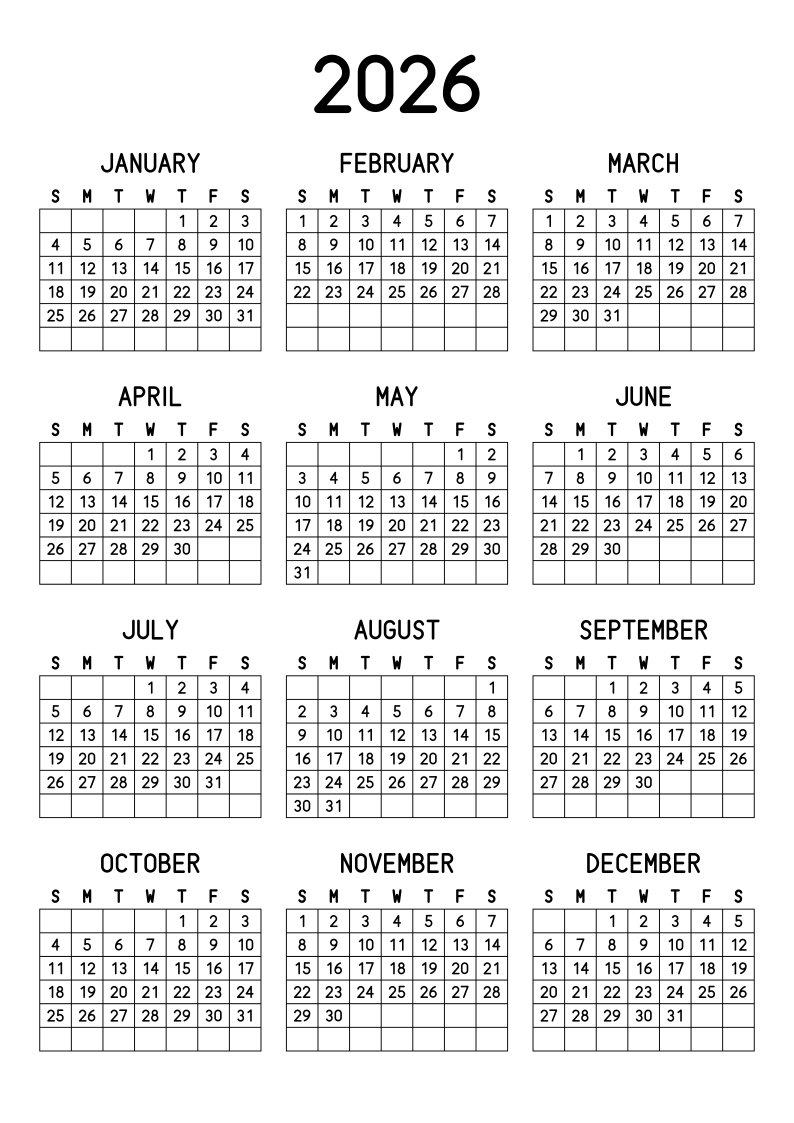
A yearly calendar on one A4 page, for any year from 2000 to 2050: the year as its title, then the twelve months, each with its name, the days of the week and its dates, set out in weeks. It comes in five designs, upright or turned sideways, in nine languages, with weeks that start on Sunday or Monday, and with full or short names for the months and the days.
The sheet always prints upright, in portrait. Vertical sets the months three across and four down, to read as it comes out of the printer. Horizontal draws the calendar in landscape, four months across and three down, and turns it a quarter turn on the sheet: turn the page to read it, or hang it sideways. The year then runs along the left edge of the sheet, with January at the bottom left.
English, French, Spanish, German, Italian, Portuguese, Dutch, Polish and Turkish. The names of the months and of the days are written in capitals, with their accents: FÉVRIER and AOÛT in French, MÄRZ in German, MARÇO in Portuguese, PAŹDZIERNIK in Polish, ŞUBAT and AĞUSTOS in Turkish.
Yes. By default, the week starts as is usual in the chosen language: on Sunday in English, as in the United States, and on Monday in the other languages, as in most of Europe. Week starts on sets Sunday or Monday for any language, for example a calendar in English with weeks from Monday, as in the United Kingdom.
Short month names write JAN, FEB and MAR instead of JANUARY, FEBRUARY and MARCH, with the usual abbreviations in French, such as JANV, FÉVR, JUIL and SEPT. Short day names write two letters instead of one: MO, TU and WE in English, LU, MA and ME in French. Portuguese has no usual two-letter forms, so SE, TE, QA, QI, SX, SÁ and DO keep every day distinct. Month numbers add the number of each month before its name: 01. JANUARY, 02. FEBRUARY.
The Gregorian calendar, introduced in 1582, is the calendar used around the world for civil dates. A year has 365 days, and a leap year has 366, with a February 29: every year divisible by 4 is a leap year, except the years ending in 00 that are not divisible by 400. So 2000 was a leap year, as are 2024 and 2028, but 2100 will not be. The generator computes every date from these rules, so each month starts on the right day of the week.
The page is made in your browser: nothing is sent to Zuzuzi, and it is free, with no sign-up. Its address keeps the settings, so it always gives the same calendar back.