Sierpinski Worksheets Generator
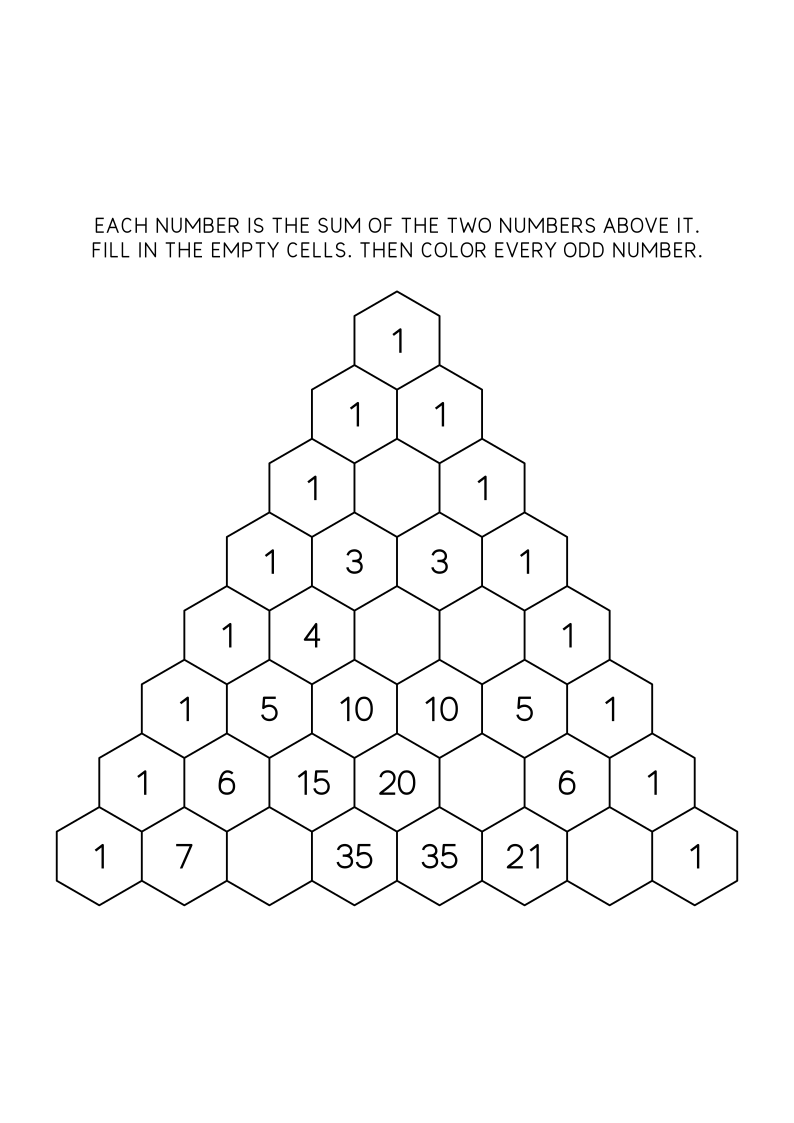
Make a math worksheet about the Sierpinski triangle, with its answer key: complete Pascal's triangle and color its odd numbers to see the fractal appear, play the chaos game with a die and a ruler, count the shaded pieces step by step, or draw the next step. Each sheet starts with its instructions, which a checkbox hides, and New gives another sheet.
Version 1. Last updated on Fri, 30 Oct 2026.
Frequently Asked Questions
What Can You Make With the Sierpinski Worksheets Generator?
Four worksheets, each with an answer key: Pascal's triangle in 8, 12 or 16 rows, with numbers to find before coloring the odd ones; the chaos game, with 10, 15 or 20 rolls of a die; a counting sheet for the triangle, the carpet or the hexagon, with a table to fill in up to step 4; and a sheet to draw the next step of the triangle or the carpet.
What Is the Sierpinski Triangle, and Why Use It in Math Class?
It is a triangle full of holes, named after Wacław Sierpiński, a Polish mathematician: take a triangle, remove the triangle in its middle, then do the same in each of the three corners left, again and again. Children who follow this rule meet powers (3, 9, 27 pieces), fractions of a side and of an area, Pascal's triangle and a game of chance, all on one shape they can draw themselves.
How Does Pascal's Triangle Draw the Sierpinski Triangle?
Each number of Pascal's triangle is the sum of the two numbers just above it. Color only the odd numbers and the Sierpinski triangle appears: odd plus even gives odd, odd plus odd gives even, and this simple rule copies the same pattern at every size. With 8 or 16 rows the triangle comes out whole, while 12 rows stop in the middle of a step.
How Do You Play the Chaos Game?
Start at point 0, already marked inside the big triangle. Look at the first die: 1 or 2 means the top corner, 3 or 4 the bottom left corner, 5 or 6 the bottom right corner. With a ruler, mark the point halfway between your last point and that corner, and write the number of the roll next to it. Then start again from this new point, die after die. The first roll is done on the sheet, as an example: point 1 sits halfway between point 0 and the corner of the first die.
Why Does the Chaos Game Make a Sierpinski Triangle?
Moving halfway toward a corner always lands in the half-size copy of the triangle at that corner, never in the hole in its middle. Roll after roll, the same holds inside each copy, so the points stay out of every hole and soon trace the Sierpinski triangle. A small mistake with the ruler is halved at each roll, which keeps the drawing right. The answer key shows the points of the sheet on a gray cloud of 2,500 points from the same game, where the triangle appears. The mathematician Michael Barnsley made this game famous.
What Does the Count Sheet Ask?
To count the shaded pieces at each step and to fill in a table up to step 4: the number of pieces, multiplied by 3 at each step for the triangle, by 8 for the carpet and by 6 for the hexagon; the side of one piece, as a part of the side of the first shape; and the part of the area left. The area left shrinks toward zero while the number of pieces grows without end, the surprise of a fractal.
How Do You Draw the Next Step?
Split each shaded piece the same way and leave its middle empty: a triangle into 4 triangles, a square into 9 squares. The dots on the sides of the empty shape show where the new lines meet them, and the instructions say which step to draw. The answer key draws the next step in dotted lines.
How Does the Sierpinski Worksheets Generator Work?
Each sheet comes from a seed, the number in its address, which New changes. The seed picks the empty cells of Pascal's triangle, each one the sum of two numbers that stay on the sheet; the start point and the rolls of the chaos game; the cells of the counting table given as hints; and the step to draw. Every answer is computed, the points of the chaos game as exact middles, and the same seed always gives the same sheet.