
Archimedean Solid Nets (7 Printables)
Archimedean solids as nets to print and fold, each built from two kinds of regular faces, from the truncated tetrahedron to the soccer ball shape.
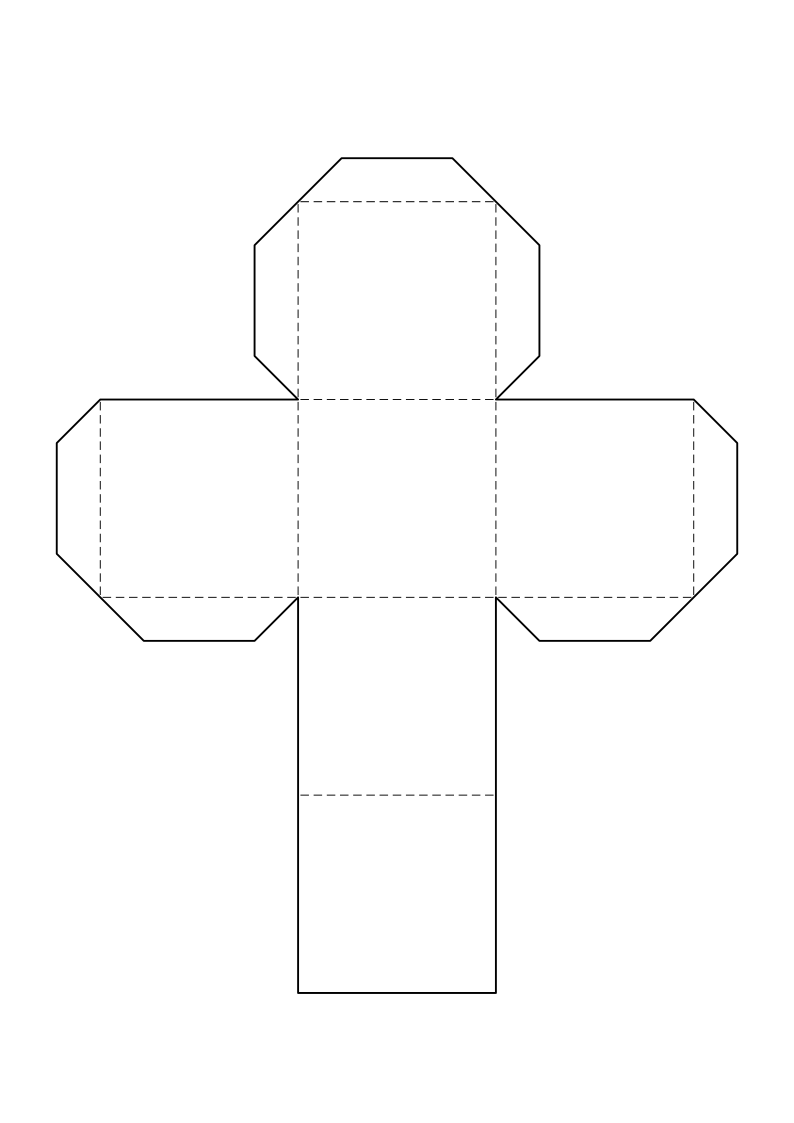
Make the net of a solid to print: a flat pattern of faces that folds up into a 3D shape. Cut along the solid lines, fold along the dashed ones, and glue each tab under the matching edge until the shape closes. The faces stay blank, ready to color, number or decorate before folding.
Pick the solid: the five Platonic solids, from the tetrahedron to the twenty-faced icosahedron; triangular, rectangular, pentagonal and hexagonal prisms; antiprisms; pyramids and bipyramids; or an Archimedean solid, up to the truncated icosahedron, the shape of a soccer ball. Each net is drawn as large as an A4 sheet allows, and the glue tabs can be left out.
Show the solid adds a drawing of the finished shape in the top corner, its hidden edges dashed. The same solid always gives the same net, so a class can build matching shapes.
Version 1. Last updated on Thu, 29 Oct 2026.
The latest printable pages whose sheets were made with this generator, ready to download.
Archimedean solids as nets to print and fold, each built from two kinds of regular faces, from the truncated tetrahedron to the soccer ball shape.

Nets of pyramids and bipyramids to cut out and fold, every triangle equilateral: a square and a pentagonal pyramid, and two double pyramids.

Nets of prisms, two equal polygons joined by squares or rectangles, and of antiprisms, where the band between the two polygons is made of triangles.

The five Platonic solids as nets to print, cut out and fold, from the four triangles of the tetrahedron to the twenty of the icosahedron.
Paper models of polyhedra, from the cube to the soccer ball: Platonic solids, prisms, antiprisms, pyramids, bipyramids and Archimedean solids, each on one A4 sheet, with or without glue tabs and a picture of the folded shape.
The surface of a polyhedron cut along some of its edges and laid flat in one piece. Folded back along the other edges, the flat faces close up into the solid. A cube alone has eleven different nets.
Cut around the outer line, tabs included. Crease every dashed line, then fold the faces up and glue each tab inside the face it meets, one edge at a time; the last faces close like a lid. Thick paper or thin card holds the shape best.
Every edge of the solid that the net cuts open has to be glued again, and one tab per edge is enough: the generator puts it on one of the two faces that meet there, where it has room without touching another face or tab. In a narrow notch between two faces, the tab gets a steeper side, and a lower edge if room is still short.
Two equal polygons, one turned by half a side against the other, joined by a band of equilateral triangles. The square antiprism has two squares and eight triangles; the octahedron is the antiprism of two triangles.
The thirteen solids whose faces are regular polygons of two or more kinds, meeting the same way at every corner. Among those the generator draws are the cuboctahedron, the rhombicuboctahedron and the truncated icosahedron, whose twelve pentagons and twenty hexagons make the classic soccer ball.
Yes, with help for the cutting. The cube, the rectangular prism and the square pyramid are the simplest to fold; solids with many faces, such as the dodecahedron, the rhombicuboctahedron or the truncated icosahedron, suit older children and adults.
The generator computes the faces of the solid from its corners in space, then unfolds them one by one around their shared edges, keeping a face only where it covers no other. The finished net is scaled to the largest size that fits under the name and date line, and moves aside or shrinks to leave room for the folded solid when it is shown.