
Multiplication Pyramids – 5 Rows (24 Printables)
Twenty-four pages of the tallest product pyramids, five rows with base factors from 1 to 5 and four-digit tops, from a full base or five scattered clues.
Make number pyramid worksheets to print: pyramids of bricks where every brick adds up the two it rests on, or, in multiplication, multiplies them. Fill in the empty bricks, going up from the bottom row, or working out the missing ones from the bricks given.
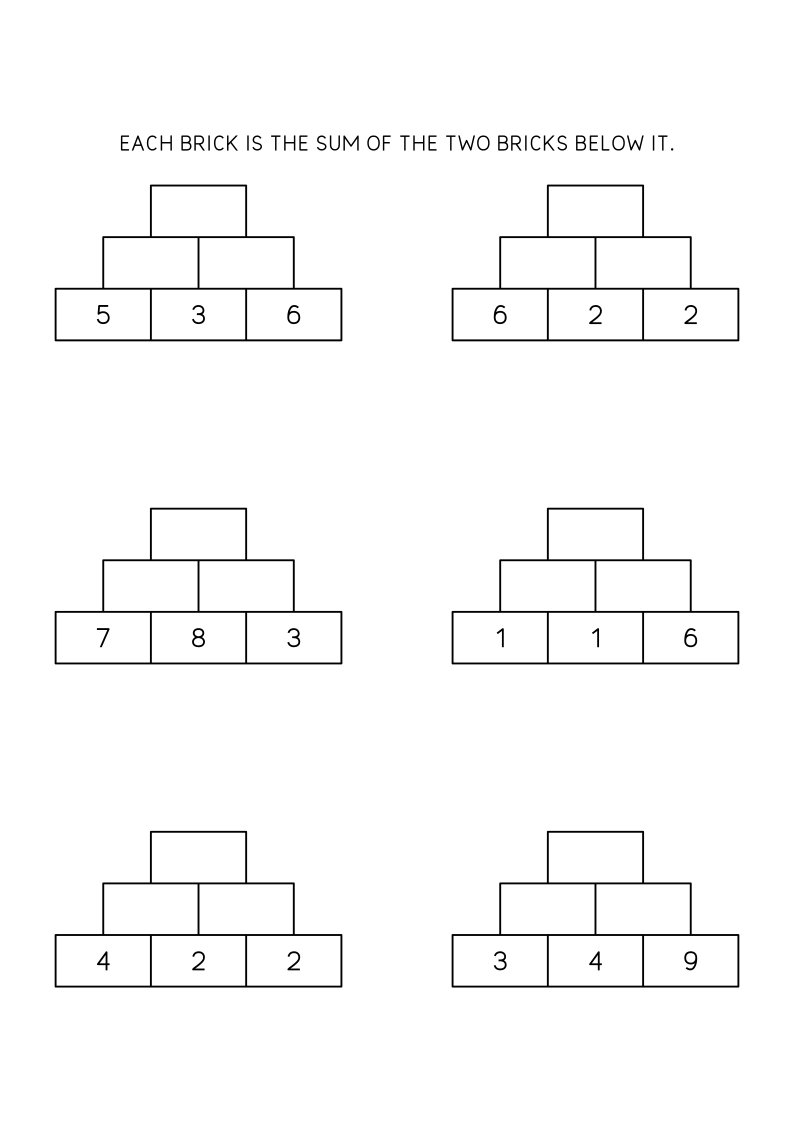
Choose the operation, addition or multiplication, the number of rows, 3, 4 or 5, and the bricks given: the whole bottom row, to add or multiply going up, or a few bricks here and there, to subtract or divide as well. Bricks keep their size whatever the Font: Pebble fills them with round, even figures, Granite with the sharper strokes of print.
Every worksheet has six different pyramids, each one solvable brick by brick, and its answer key fills every brick in orange dots.
Version 7. Last updated on Mon, 02 Nov 2026.
The latest printable pages whose sheets were made with this generator, ready to download.
Twenty-four pages of the tallest product pyramids, five rows with base factors from 1 to 5 and four-digit tops, from a full base or five scattered clues.

Twenty-four pages of four-row multiplication pyramids, products growing fast to a top of 2,000 at most, half from a full base and half from four clues.

Twenty-four pages of three-row product pyramids, where a brick multiplies the pair beneath it, with bases drawn from 1 to 9 and clue pages that bring in division.

Twenty-four pages of tall addition pyramids, five rows and fifteen bricks each, the longest chains of sums in the set, with a full base or five clues to begin.
Number pyramid worksheets at six levels, 3, 4 or 5 rows from a full bottom row or from a few scattered bricks, in addition or in multiplication: six pyramids to a page, each sheet with an answer key that fills in every brick. One line at the top reminds children how a brick gets its number from the pair it rests on, by addition or by multiplication; turning off Show the instructions prints the pyramids alone.
In a number pyramid, every brick is worth the two bricks under it added together. When the bottom row is given, you add each pair of neighbors to build the pyramid up to the top. When the given numbers are spread out, you also subtract: a brick minus one of the two bricks below it gives the other one. Number pyramids practice addition and subtraction facts, and show how numbers combine, step by step. A multiplication pyramid works the same way, with products and quotients.
Start with 3 rows and the bottom row given: three numbers to add in pairs, then one more addition for the top brick. Four and five rows make longer chains and bigger numbers. Some Bricks Given asks for both directions: going up adds, going down subtracts, and the child decides where to begin, with always a brick that can be found from two known ones.
Here every brick is worth the two under it multiplied together, so the numbers grow quickly: the bottom row stays small, from 1 to 9 with 3 or 4 rows and from 1 to 5 with 5 rows, and the top brick stays at most 200, 2,000 or 9,999, four digits that fit in their brick. With some bricks given, the child divides a brick by one of the two below it to find the other, which turns the times tables and division facts into a puzzle. A 1 just copies its neighbor into the brick above, so the bottom row has at most one 1, two with 5 rows.
The top brick can be computed straight from the bottom row, and the weights are the numbers of Pascal’s triangle. With 3 rows, the top is the first number plus twice the middle one plus the last, the weights 1, 2, 1; with 4 rows, they are 1, 3, 3, 1, and with 5 rows, 1, 4, 6, 4, 1. A bottom row of 2, 5, 3 gives 2 + 10 + 3 = 15 at the top. In multiplication, the weights become powers: the same row gives 2 × 5 × 5 × 3 = 150. The middle bricks count most, which is why a large number in the middle of the bottom row makes the top grow fastest.
Each empty brick is filled in orange dots, and the bricks given at the start stay black, so a page of six pyramids can be checked brick by brick, from the bottom row up.
Addition pyramids of 3 rows, with a bottom row up to 9, suit first and second graders adding within 20 and then within 100; 4 and 5 rows, whose top brick can reach 160, fit second and third graders. Some Bricks Given brings in subtraction, a good step once children see addition and subtraction as two sides of one fact. Multiplication pyramids follow the times tables of third grade, and their larger tops suit fourth and fifth graders multiplying bigger numbers.
The generator draws a bottom row at random within the numbers of the level and builds the pyramid up to its top brick. In addition, the bottom numbers go up to 9 with 3 rows, 12 with 4 and 10 with 5, so that the top brick stays at most 160; in multiplication, a bottom row whose top brick would be too big is drawn again. For Some Bricks Given, it picks as many bricks as rows, never the whole bottom row, and keeps the choice only if the pyramid can be solved one brick at a time. The six pyramids of a page have different bottom rows, and the seed kept in the address draws them again.