
9x9 Sudoku (32 Printables)
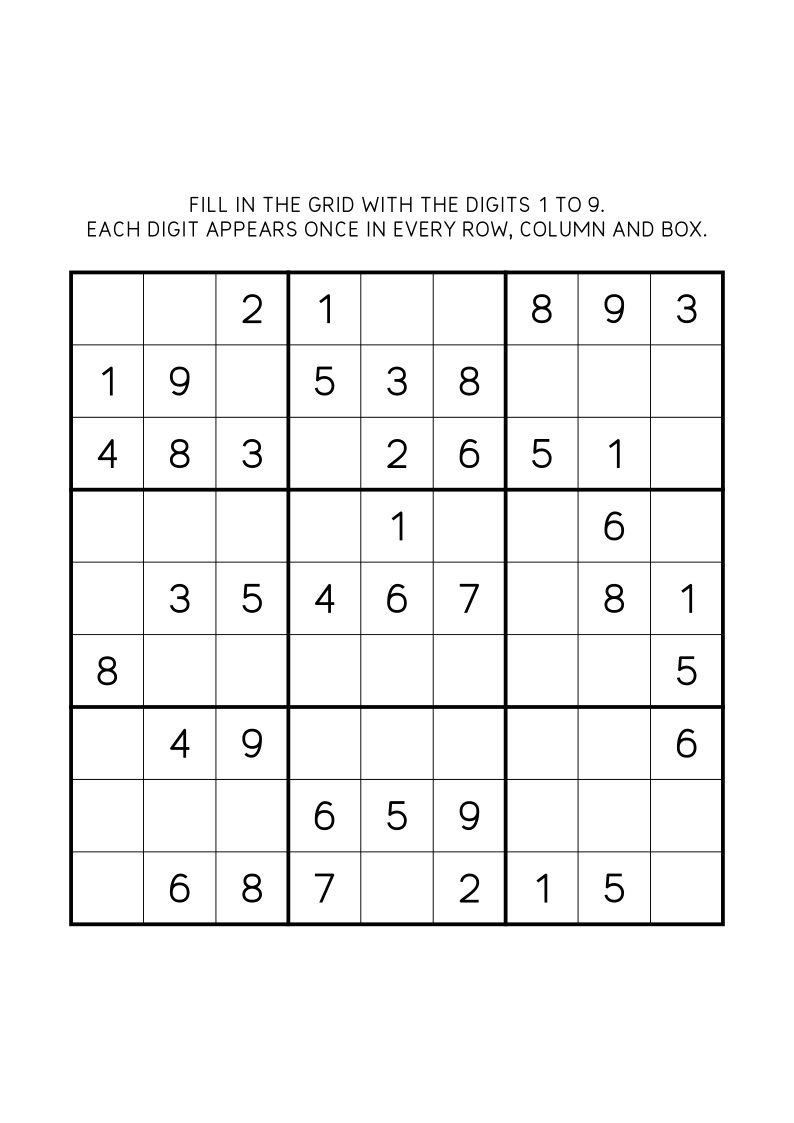
Classic nine-by-nine sudokus, one per page, graded from easy to very hard by the clues they give and the techniques they need.
Make a sudoku to print, the puzzle first published in the United States as Number Place, in three sizes and four levels, from Easy to Very Hard: 4x4 grids with the digits 1 to 4, a gentle start for children; 6x6 grids with 1 to 6; and classic 9x9 grids with 1 to 9, which also come at a fifth level, Expert. Every grid has exactly one solution, reached by logic alone, without guessing.
Choose the size and the level, then print one grid per page, or four grids that share them. The level sets how many digits are given and, on a 9x9 grid, which reasoning the grid asks for. Under Font, the digits come in Pebble, rounded like the lettering of a phone, or in Granite, with the thick and thin strokes of a printed book; the grid does not change.
New draws another grid, and Show the solution fills in the missing digits in orange dots, which stand apart from the given ones even in black and white.
Version 9. Last updated on Mon, 02 Nov 2026.
The latest printable pages whose sheets were made with this generator, ready to download.
Classic nine-by-nine sudokus, one per page, graded from easy to very hard by the clues they give and the techniques they need.

Full 9x9 sudokus, four to a sheet and one level per sheet, to carry in a bag or share around a table.

The step between 4x4 and 9x9: six-by-six sudokus, one grid to a page, from easy to very hard.

Sheets of four 6x6 sudokus, one level per sheet, for practice in series, homework or cards to cut out.
Thirteen kinds of sudoku to print: the 4x4, 6x6 and 9x9 sizes, each at four levels, Easy, Medium, Hard and Very Hard, and the 9x9 size at Expert too. A sheet holds one grid or four, and every grid comes with an answer key. Each sheet opens with two short lines that state the rules of the grid, so it can be handed out without a word of explanation; unchecking Show the instructions leaves just the grids.
The goal of sudoku is to fill every empty cell so that each row, each column and each box holds every digit exactly once: 1 to 4 in a 4x4 grid, 1 to 6 in a 6x6 grid, and 1 to 9 in a 9x9 grid. First printed in American puzzle magazines in 1979 as Number Place, the game took the Japanese name sudoku in the 1980s. Sudoku needs no math: the digits are only symbols, and each one can be found by logic, without guessing. Solving a grid trains logical thinking, concentration and patience.
The 4x4 grid, with four boxes of 2 x 2 cells, teaches the rule in a few minutes and suits young children. The 6x6 grid, with boxes of two rows of three, is the next step. The 9x9 grid is the classic sudoku: Easy and Medium for regular players, Hard and Very Hard for those who know the techniques, Expert for those who also know the X-wing. Four grids per page suit a class or a journey: same size and level, four different puzzles.
The fewer the digits given, the harder the grid. A 4x4 grid gives 7 digits at Easy, 6 at Medium, 5 at Hard and 4 at Very Hard. A 6x6 grid gives 26, 19, 16 and 12. A 9x9 grid gives 40, 30, 25 and 24, then 22 to 24 at Expert, and from Hard on it also asks for harder reasoning: locked candidates at Hard, pairs and triples at Very Hard, an X-wing or a swordfish at Expert. The first four levels follow the sudokus already published on Zuzuzi, read and solved level by level.
They are the steps a player takes when no digit is forced. Forced digits come first: a cell with only one possible digit left takes it, and a digit that fits in only one cell of its row, column or box goes there. Locked candidates: when a digit, inside a box, can only go on one row, it cannot go anywhere else on that row, and the same holds for a column. Pairs and triples: when two cells of the same row, column or box can only hold the same two digits, those digits are theirs, and the other cells of that group lose them; likewise with three cells and three digits. Easy and Medium grids, and every 4x4 and 6x6 grid, need forced digits only.
They are the steps an Expert grid asks for, once forced digits, locked candidates, pairs and triples no longer help. X-wing: when a digit, in two rows, can only go in the same two columns, it must fill these two columns within the two rows, so the other cells of the two columns lose it. Swordfish: the same with three rows and three columns. Both work with columns in place of rows too. They show best when you mark, across the whole grid, every cell where one digit can still go.
Yes, once the obvious digits are placed. Writing the digits still possible for a cell, small in its corner, is called pencil marking, and it is what makes the harder levels manageable: a pair, a triple or an X-wing only shows when every candidate is on the paper. Use a pencil with an eraser, cross out a candidate as soon as its row, column or box rules it out, and at Easy and Medium mark only the cells you are working on, since forced digits are enough there.
A badly made one can, and then logic stalls and a guess has to decide. Every grid from this generator has exactly one solution, checked digit by digit as the grid is emptied. So if two digits seem to fit the same cell late in the game, an earlier digit is wrong; comparing with the answer key shows where the grid went astray.
Show the solution prints the same grid with every empty cell filled, the missing digits written in orange dots and the given ones left in black, so a solver can check a row at a time without confusing the two. On a page of four, each grid gets its completed copy in the same place.
The 4x4 grid suits children from about five or six who know the digits 1 to 4, and the 6x6 grid children of seven or eight who can keep track of boxes of six cells. The 9x9 grid at Easy is within reach of most children from nine or ten, and of beginners of any age; Hard, Very Hard and Expert are for practiced solvers, teenagers and adults alike.
The generator first fills a whole grid at random: it will be the solution. Then it empties cells in a shuffled order, and each digit taken away stays out only if the grid still has a single solution, until only the digits of the level are left. Finally it solves the grid as a player would, always with the simplest step that works: the hardest step needed must match the level, or it starts over with a new grid. An Expert grid is too rare for that, about one emptied grid in six hundred: it starts from one of 120 grids found in advance, then renumbers its digits, shuffles its bands, stacks, rows and columns, and flips it over its diagonal one time in two, which gives another grid with a single solution, asking for the same reasoning. The seed of each grid sits in the address of its page: open that address again, and the same sudoku comes back.