Four 6x6 calcudoku grids per sheet, the largest size, with the digits 1 to 6 and cages to add, subtract, multiply or divide. A dense set for confident solvers, sorted by operations, with every sheet in one book.
Make a Calcudoku to print: a math puzzle where no number may appear twice in a row or a column, and thick cages give a target and an operation that their numbers must reach. No number is given: the cages are the clues.
Choose the size, 4x4, 5x5 or 6x6, and the operations of the cages, addition only, addition and subtraction, or all four operations, then print the grids one or four to a sheet. Each Calcudoku has a single solution that logic reaches step by step.
Press New for another puzzle; Show the solution then writes every number of the grid in orange dots.
Version 2. Last updated on Wed, 28 Oct 2026.
The latest printable pages whose sheets were made with this generator, ready to download.

Four 6x6 calcudoku grids per sheet, the largest size, with the digits 1 to 6 and cages to add, subtract, multiply or divide. A dense set for confident solvers, sorted by operations, with every sheet in one book.

Sheets of four 5x5 calcudoku grids, one step up from the 4x4: the digits 1 to 5 and cages of two to four cells, with addition only, addition and subtraction, or all four operations, and a book of every sheet.

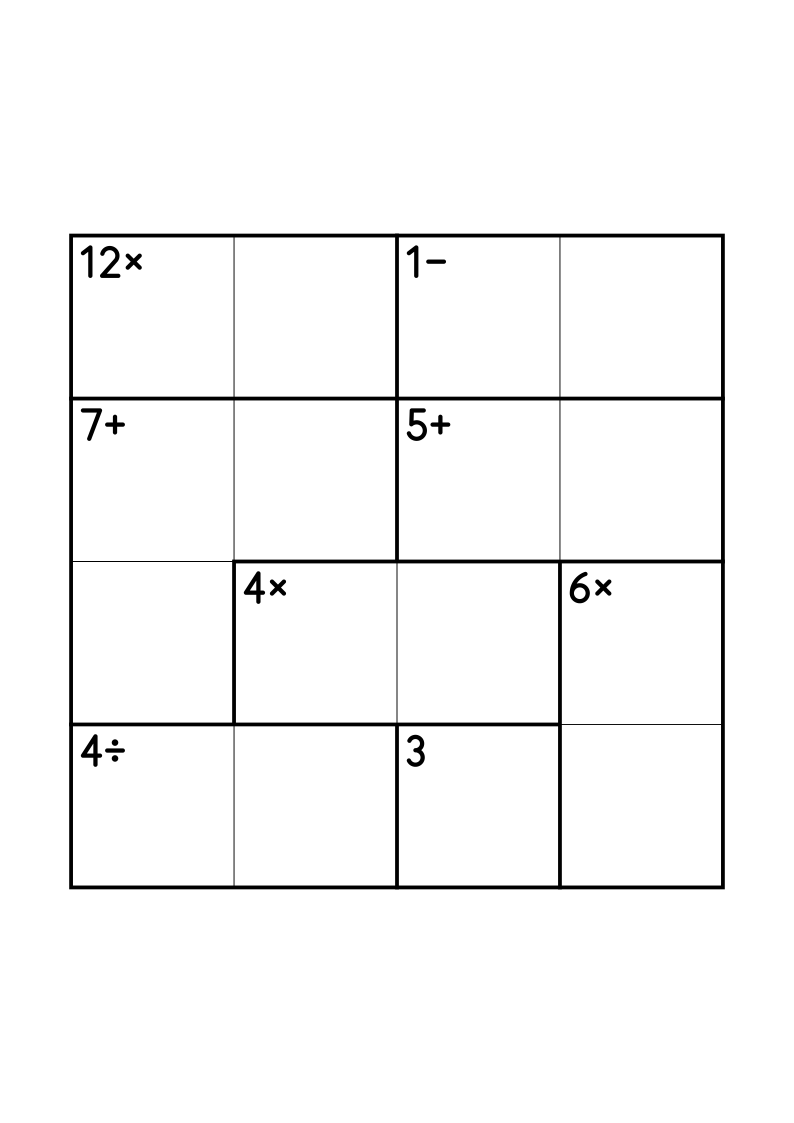
Four small 4x4 calcudoku grids per sheet, with the digits 1 to 4 and cages that call for sums, differences, products or quotients. Quick puzzles for children learning mental math, sorted by operations, with a book of every sheet.
Calcudoku puzzles in nine combinations, three sizes by three sets of operations, printed singly or four to a page. Each puzzle has a single solution, which its answer key fills in, number by number.
Calcudoku is a math puzzle on a grid: every number from 1 to the size of the grid appears once in each row and once in each column. The grid is split into cages, outlined in bold, and each cage shows a target number and an operation. The numbers of a cage must give the target with that operation: added, multiplied, or, in a cage of two cells, the larger number minus the smaller one, or divided by it. A one-cell cage simply shows its number. Calcudoku turns arithmetic practice into a puzzle, and builds number sense and logical thinking.
Addition only is the place to start: each cage adds up to its target, like a killer sudoku without boxes. Addition and subtraction bring cages of two cells marked with −, the difference of their numbers. All four operations add products, marked ×, which grow fast and often leave few choices, and quotients of two cells, marked ÷. The size counts too: a 4x4 grid with addition is a first puzzle, a 6x6 grid with all four operations a real workout.
Yes, unlike in killer sudoku: a cage of three or four cells can hold the same number twice, as long as the two are not in the same row or column, and its operation counts both. In an L-shaped cage marked 8+, the numbers 3, 2 and 3 work when the two 3s sit in different rows and columns. A cage of two cells always holds two different numbers, since its cells share a row or a column.
The generator draws a full Latin square at random, the solution, then cuts it into cages of up to four neighboring cells, more than half of them pairs and about one in ten a single cell, and gives each cage one of the chosen operations that fits it, with its target. A grid survives only if a solver working without guesses completes it, which proves the solution is unique; otherwise a new grid is drawn. The page address stores the seed of its puzzles, and the four grids of a sheet all differ.