
8x8 Kakuro (24 Printables)
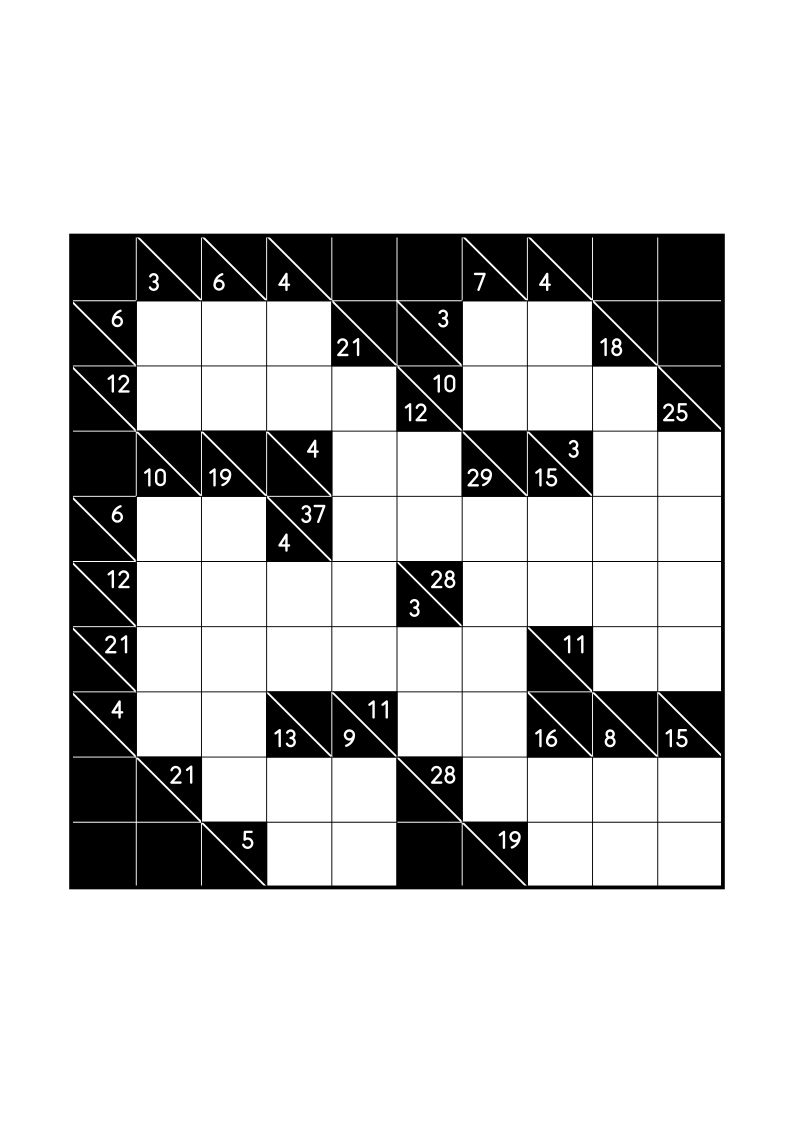
8x8 kakuro grids, one per page: longer runs, up to six digits, and more places where runs cross, at Easy, Medium and Hard. The step after the 6x6 grids, collected in one book.
Make a Kakuro to print, the number puzzle also known as Cross Sums: a crossword of numbers, where each white cell takes a digit from 1 to 9 and each run of white cells, across or down, adds up to the clue in the black cell before it, without the same digit twice. Four sizes, from 6x6 to 12x12, and three levels.
Choose the size of the grid, the level and, on the 6x6 and 8x8 grids, one or four grids per page. Easy is solved from the digit combinations of the clues; Medium also asks where the digits of a combination can still go; Hard asks you to test whole runs against their cells. Every grid has a single solution, and logic alone leads to it.
New draws another grid at every press; Show the solution writes every digit of its answer in orange dots.
Version 1. Last updated on Thu, 29 Oct 2026.
The latest printable pages whose sheets were made with this generator, ready to download.
8x8 kakuro grids, one per page: longer runs, up to six digits, and more places where runs cross, at Easy, Medium and Hard. The step after the 6x6 grids, collected in one book.

Four 8x8 kakuro grids on every sheet, with runs up to six cells, at three levels: a compact set of number crosswords for steady practice, in one book.

Small kakuro grids, one per page: a 6x6 layout whose runs hold at most five digits, at three levels. The gentlest way into cross sums, with every page in one book.
Kakuro puzzles on grids of 6x6, 8x8, 10x10 and 12x12 cells, at three levels, to print one to a page, or four to a page on the two smallest grids; Show the solution gives the answer key of each. A size counts every cell, the black row and column of the first clues included.
Kakuro, called Cross Sums in the American puzzle magazines where it began, is a crossword with numbers instead of words. Each black cell with a diagonal holds one or two clues: the number above the diagonal is the sum of the white cells to its right, up to the next black cell, and the number below it the sum of the white cells under it. Write a digit from 1 to 9 in every white cell so that each run reaches its sum, never using the same digit twice in one run. Kakuro trains mental addition and logical thinking, and suits adults and older children who already enjoy sudoku.
Look first for the clues that allow a single set of digits. Two cells that add up to 4 can only hold 1 and 3, and two that add up to 16 only 7 and 9; three cells make 7 only with 1, 2 and 4, and 23 only with 6, 8 and 9. Then look where two runs cross: the shared cell takes a digit that both runs allow, so where a 4 in two cells crosses a 7 in three cells, the cell can only be 1. Pencil in the candidates of a cell and strike them off one by one as the runs close.
The size sets the length of the runs: the 6x6 grid, with runs of up to five cells, makes a quick first puzzle; the 8x8 and 10x10 grids take longer, with more runs crossing; the 12x12 grid, with runs of up to eight cells, makes a long session. The level sets the reasoning: Easy only asks for the combinations of each clue and the digits already placed; Medium also asks where each digit can still go, such as a digit that every possible combination of a run needs and only one of its cells can take; Hard asks you to check whole runs, keeping in each cell only the digits of a complete way to fill its run. Start with an Easy 6x6 or 8x8 grid, then raise one setting at a time.
The generator first lays out the grid: black cells in pairs that mirror each other through the center, as in printed Kakuro, every run at least two cells long and every white cell connected to the others. It fills the white cells with random digits, never twice in a run, which gives the clues, then solves the grid with the reasoning of the chosen level, without ever guessing. While the solver is stuck, the generator changes a digit it could not find and tries again. A grid the solver completes has exactly one solution, and it is kept only if the reasoning of the level below cannot complete it. The seed in the address of the page brings the same grid back, so a link shares that exact puzzle; on a page of four, the four grids always differ.