Futoshiki Generator

Make a Futoshiki to print: a Japanese logic puzzle where each row and each column holds every number once, like a sudoku without boxes, and the greater-than signs between neighboring cells must stay true. Four sizes, from 4x4 to 7x7, and three levels: the bigger the grid and the fewer its numbers, the harder the puzzle.

Choose the size of the grid, the level and one or four grids per page. At Medium, a grid gives at most two numbers, three on the 6x6 and 7x7 grids, and leans on its signs: every number and sign left on it is needed. Easy adds a few numbers and signs; Hard gives no number at all, only signs. At every level, the one solution is reached by reasoning, never by guessing.

Each press of New brings another grid, and Show the solution completes it in orange dots.

Version 2. Last updated on Wed, 28 Oct 2026.

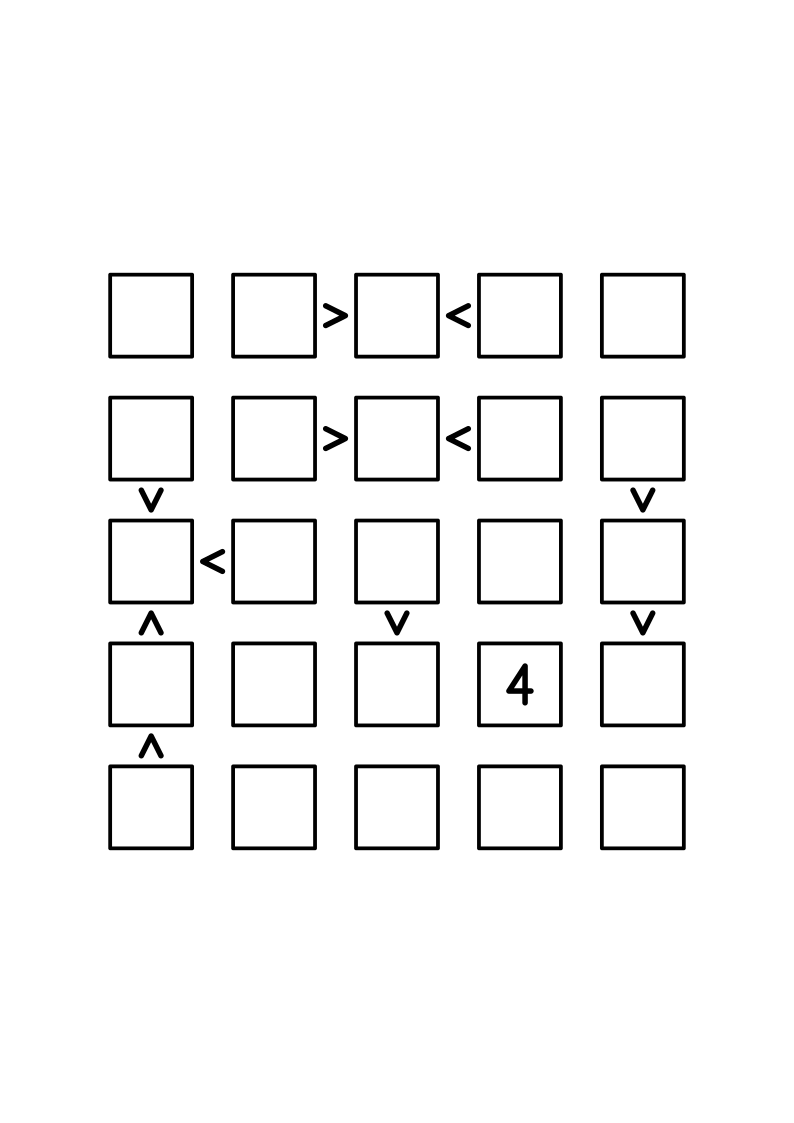
An example page of the Futoshiki Generator, ready to print.

Examples

The latest printable pages whose sheets were made with this generator, ready to download.

A sheet of four 7x7 futoshiki grids, each with chains of inequality signs between its cells, in black on white.
7x7 Futoshiki – 4 per Page (24 Printables)

Sheets of four 7x7 futoshiki grids, the largest size of the game, with the digits 1 to 7 and long chains of inequality signs, in easy, medium and hard levels, all collected in one book.

A 7x7 futoshiki grid with inequality signs between its cells and a few given digits, in black and white.
7x7 Futoshiki (24 Printables)

7x7 futoshiki puzzles, one grid per page: forty-nine cells, the digits 1 to 7 and signs that link across the grid, at three levels. The largest grid of the game, for patient solvers, with every page in one book.

A sheet of four 6x6 futoshiki grids with inequality signs between many of the cells, in black on white.
6x6 Futoshiki – 4 per Page (24 Printables)

Four 6x6 futoshiki grids per sheet, each filled from 1 to 6 under plenty of inequality signs, sorted into easy, medium and hard sheets. A step up from 5x5 for solvers who enjoy longer deductions, bound in one book.

Frequently Asked Questions

What Can You Make With the Futoshiki Generator?

Futoshiki grids of 4x4, 5x5, 6x6 and 7x7 cells at three levels, with their inequality signs and, except at Hard, a few given numbers, to print one or four to a page. The answer key shows the finished grid.

How Do You Play Futoshiki?

Futoshiki is a Japanese logic puzzle whose name means “inequality”. Every empty cell takes a number between 1 and the size of the grid, and no number repeats in a row or a column: on a 5x5 grid, each row and each column holds 1, 2, 3, 4 and 5. Every sign between two cells must stay true once the grid is full. Futoshiki trains logical thinking, and makes greater than and less than concrete.

How Do You Read the Signs?

The point of a sign faces the smaller number and its open side the larger one, between two cells side by side as between two cells one above the other. A cell that is greater than a neighbor cannot hold 1, and a cell that is smaller than a neighbor cannot hold the largest number of the grid. Chains say even more: on a 4x4 grid, three signs in a row, each pointing the same way, fix the four numbers from 1 to 4 along the row.

Which Futoshiki Size and Level Should I Choose?

The 4x4 grid uses the numbers 1 to 4 and suits a first try; the 5x5 grid adds a number and many more possibilities; the 6x6 and 7x7 grids are for experienced solvers. The level sets the clues: Medium gives at most two numbers, three on the 6x6 and 7x7 grids, and only the signs that are needed; Easy adds as many numbers as a row has cells, minus one, and as many signs as a row has cells, so 3 numbers and 4 signs more on a 4x4 grid; Hard gives no number at all, and every step starts from the signs. Two grids of the same size and level can still feel very different, depending on how their signs chain together.

How Does the Futoshiki Generator Work?

The generator starts from a full Latin square, a grid where each number appears once in each row and column, with every number written and every sign between neighbors. It then removes the numbers, then the signs, one at a time in a random order, keeping each removal only if a solver that never guesses still finishes the grid. What is left is needed: with one more number or sign removed, logic alone could no longer finish the grid. A grid that keeps more than two given numbers, three from 6x6 up, is set aside, so that the signs carry the puzzle. That is a Medium grid. For Easy, the generator gives back some of the numbers and signs it removed; for Hard, it keeps only the grids left without a single number, about one in two on a 4x4 grid and one in eight on a 7x7.