
8x8 Star Battle (24 Printables)
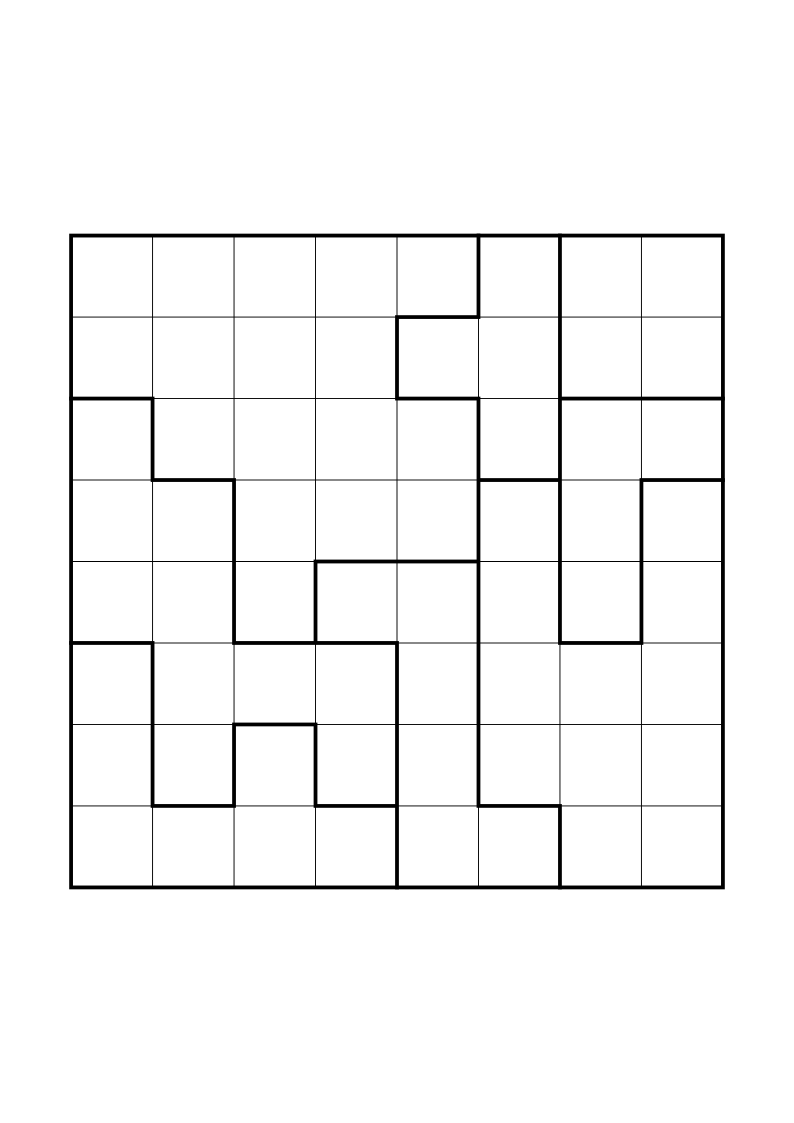
The largest star battle, 8x8, one grid per page: eight regions and eight stars to place, at three levels, by the same rules as the Queens puzzle. With every page in one book.
Make a Star Battle to print: a grid divided into regions, where you place one star in every row, every column and every region, and no two stars may touch, not even diagonally; with queens for stars, it is also the Queens puzzle played on LinkedIn. Four sizes, from 5x5 to 8x8, and three levels, with one grid or four on a sheet.
Easy grids give way to simple observations, such as a region that fits in a single row; Medium asks you to reason about two or three regions at once; Hard asks you to test a star in your head and follow it to a contradiction. Every grid has one solution, and you never have to guess. At Easy, Initial stars can give one, two or three stars of the solution to start from, drawn solid in the grid.
New brings another layout of regions; Show the solution outlines every other star in orange dots, so that a found star never looks like a given one.
Version 1. Last updated on Thu, 29 Oct 2026.
The latest printable pages whose sheets were made with this generator, ready to download.
The largest star battle, 8x8, one grid per page: eight regions and eight stars to place, at three levels, by the same rules as the Queens puzzle. With every page in one book.

Four 8x8 star battle grids on every sheet, eight regions each, at three levels: the largest size in a compact series, by the rules of the Queens puzzle, gathered in one book.

7x7 star battle grids, one per page: seven regions and seven stars, with longer chains of deductions, at three levels. For solvers who know the small grids, gathered in one book.
Star Battle puzzles on 5x5, 6x6, 7x7 and 8x8 grids, each split into as many regions as it has rows, at three levels. Print one grid on a sheet, or four smaller ones; at Easy, up to three initial stars can be given; Show the solution adds the stars of every grid.
Each row, each column and each outlined region of the grid holds exactly one star. Stars cannot touch each other, not even at a corner, so every star leaves the eight cells around it empty. Mark the cells that cannot hold a star with a small dot, and place a star as soon as a row, a column or a region has only one cell left. Star Battle is a pure logic puzzle: no numbers, no arithmetic, just careful elimination. Puzzle books also print it as Two Not Touch, with two stars in every row, column and region; the version here has one, like LinkedIn’s Queens.
Look at the smallest regions first. A region of three cells in a row forces its star into that row, so every other cell of the row is empty. A cell that touches every cell of a small region cannot hold a star, since that region would be left without room for its own: in an L-shaped region of three cells, the cell that fills the corner of the L is always empty. When two regions both lie entirely within the same two rows, the two stars of those rows belong to them, and every other cell in those rows is empty.
The 5x5 and 6x6 grids are quick, a good way to learn the rules; the 7x7 and 8x8 grids take longer, with more regions to keep in mind. Easy grids are solved with single regions, rows and columns, and with cells that would crowd a region out; Medium needs groups of two or three regions or rows seen together; Hard sometimes needs a trial star, followed until it breaks a rule. Start with an Easy 6x6 grid, or four of them on one sheet; Initial stars, at Easy, gives one to three stars to begin with, a gentle way into a first grid.
The generator first places the stars of the solution, one in each row and column, none touching, then grows one region around each star, cell by cell, at random. A search then looks for another solution; while it finds one, the generator moves a cell from one region to its neighbor so that the other solution would break the rules while the original one still holds. Once the solution is unique, a solver that never guesses works through the grid with the reasoning of the chosen level; a grid it finishes, and that the easier level could not, is kept. The page address holds the seed, so the same link always shows the same grid.