Sierpinski Fractals Generator
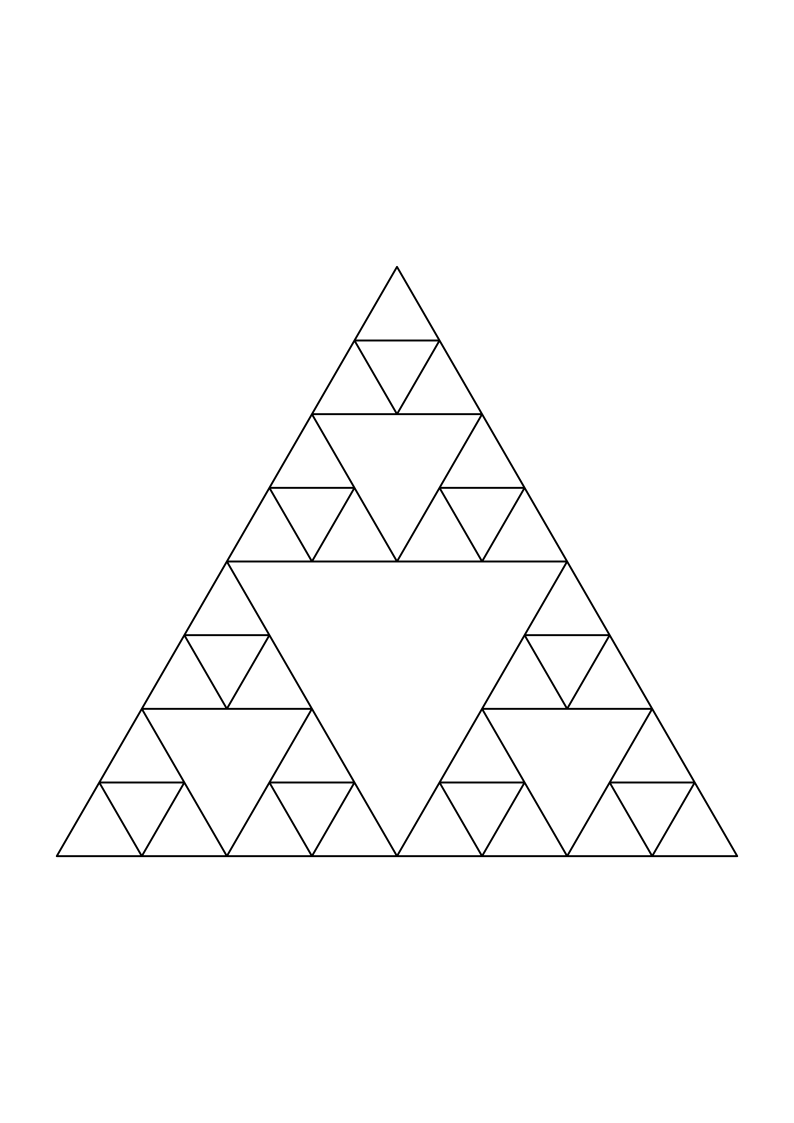
Make a Sierpinski fractal to color: the Sierpinski triangle, also called the Sierpinski gasket or the Sierpinski sieve, the Sierpinski carpet, the pentagon or the hexagon, each one built from smaller copies of itself. Choose the shape and the step, then print an outline drawing, a sheet of the first four steps, or a color by step page where every hole carries the step that opened it.
Version 1. Last updated on Fri, 30 Oct 2026.
Frequently Asked Questions
What Can You Make With the Sierpinski Fractals Generator?
Three kinds of pages, for the triangle, the carpet, the pentagon and the hexagon: a coloring page at one step, from 1 to 6 for the triangle and from 1 to 3 for the other shapes; the steps from 0 to 3 on one sheet, to watch the pattern grow; and a color by step page, where each hole is numbered by the step that opened it, with a key of boxes to fill with the color picked for each number.
What Is the Sierpinski Triangle?
A fractal described by the Polish mathematician Wacław Sierpiński in 1915, which Benoit Mandelbrot later called the Sierpinski gasket. Start from a filled triangle, cut out the triangle that joins the middles of its sides, then do the same to each of the three triangles left, step after step. The same pattern shows at every scale. As a design, it is much older: it already decorates Italian mosaics of the 13th century.
Why Do the Steps Stop at 6 or 3?
So that the smallest piece stays large enough to color. On an A4 sheet, the smallest triangle at step 6 is about 2.8 mm wide. The three other shapes stop at step 3, since their pieces shrink faster at each step: to a third of their size for the carpet and the hexagon, and to 0.382 for the pentagon.
What Are the Sierpinski Carpet, Pentagon and Hexagon?
Cousins of the triangle, built on the same idea. The carpet, which Sierpiński described in 1916, divides a square into nine and removes the middle one. The pentagon keeps five smaller pentagons that touch at their corners, each 0.382 times as wide, the inverse of the golden ratio squared. The hexagon keeps six hexagons a third as wide, and the hole in its middle grows into the outline of a Koch snowflake.
How Does Color by Step Work?
Each hole carries the number of the step that opened it: 1 for the large hole in the middle, 2 for the holes of the next step, and so on. Pick a color for each number and fill its box in the key at the bottom, then color the holes: the colors show the same pattern repeating at every size. The triangle goes to step 4, the carpet to step 3, the pentagon and the hexagon to step 2, so that every number stays readable.
Does the Same Setting Always Give the Same Page?
Yes. A Sierpinski fractal has one single form at each step, so the shape and the step settle the whole page, and its address keeps them to print it again later. Variety comes from the four shapes, the steps and the three kinds of pages.
How Does the Sierpinski Fractals Generator Work?
Every shape is a rule, not a drawing. The generator starts from the full shape and replaces it with smaller copies of itself set in its corners: three copies half as wide for the triangle; eight copies a third as wide for the carpet, one in each corner and one in the middle of each side; five copies about 0.382 times as wide for the pentagon; six copies a third as wide for the hexagon. Each new step applies the same rule to every piece, so step 3 of the triangle holds 27 triangles and step 6 holds 729. Every corner is computed exactly, with square roots, and nothing is traced by hand.