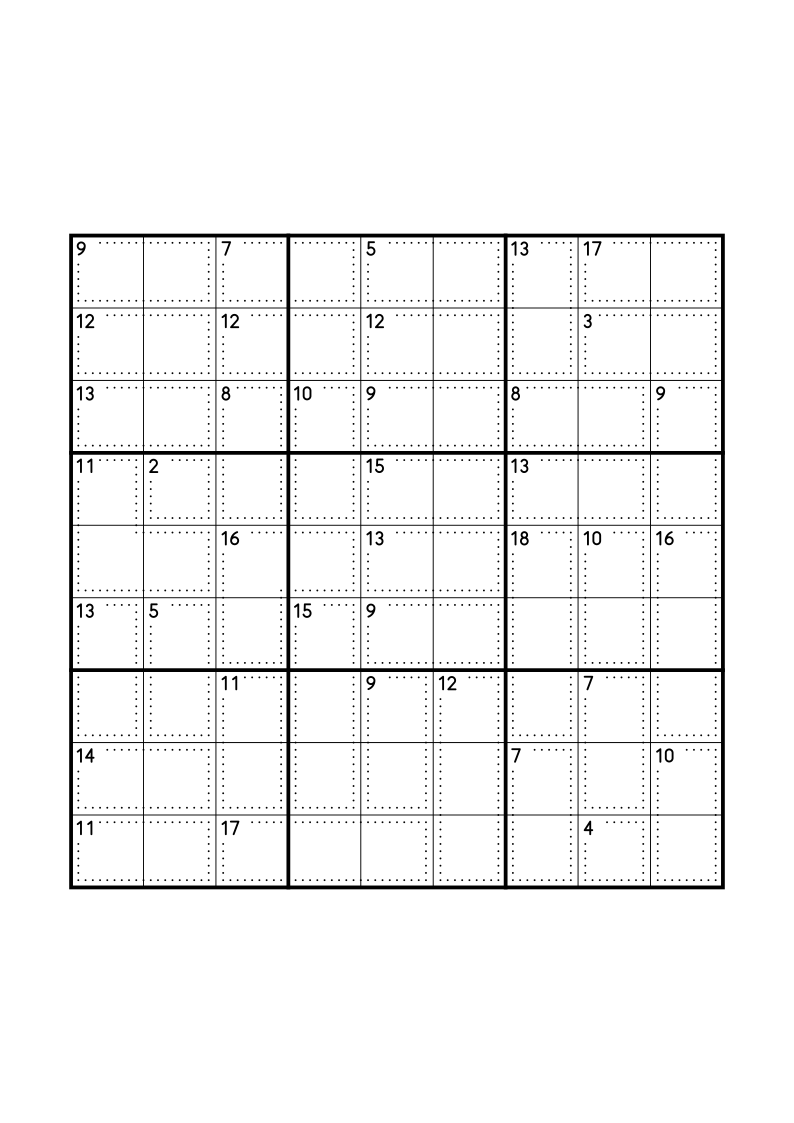
Four classic 9x9 killer sudoku grids per sheet, at three levels: eight given digits on the easy sheets, none on the medium ones, four-cell cages on the hard ones. A compact format for regular solvers, collected in one book.
Make a killer sudoku to print: a sudoku grid cut into cages outlined with dots, each showing the sum of its digits. It mixes the logic of sudoku with addition, in three sizes, 4x4, 6x6 and 9x9, and three levels.
Pick the size, the level and whether the page holds one grid or four. Easy gives a few digits and keeps the cages small, two or three cells; Medium starts from an empty grid, with cages of two to four cells, three at most on the 9x9 grid; Hard leaves the grid empty too, with larger cages. A digit never repeats inside a cage, and each grid can be solved in only one way, by logic alone.
Every click on New brings a fresh grid, and its answer key, under Show the solution, fills every empty cell in orange dots.
Version 2. Last updated on Wed, 28 Oct 2026.
The latest printable pages whose sheets were made with this generator, ready to download.

Four classic 9x9 killer sudoku grids per sheet, at three levels: eight given digits on the easy sheets, none on the medium ones, four-cell cages on the hard ones. A compact format for regular solvers, collected in one book.

Full 9x9 killer sudoku for solvers who know regular sudoku: easy grids start from eight digits, medium grids from the sums alone, hard grids from four-cell cages. Every page carries one grid, and the book gathers the set.

Sheets of four 6x6 killer sudoku grids filled with the digits 1 to 6, in easy, medium and hard levels: compact practice between the 4x4 and the 9x9, also bound into a single book PDF.
Killer sudoku puzzles on 4x4, 6x6 and 9x9 grids, at three levels, Easy, Medium and Hard, one or four per sheet, each with its answer key.
Killer sudoku keeps the rule of sudoku, every digit once in every row, column and box, but gives few digits or none: at Medium and Hard, the grid starts empty. Dotted lines group its cells into cages, and the small number in the corner of each cage is the sum of its digits; within a cage, no digit appears twice. Killer sudoku combines the logic of sudoku with addition practice, and trains planning ahead and checking your work.
Begin with the cages that leave few choices. A cage of two cells with a sum of 3 can only hold 1 and 2, and one with 17 on a 9x9 grid only 8 and 9; a cage of a single cell gives its digit straight away. Then use the totals: every row, column and box adds up to 10 on a 4x4 grid, 21 on a 6x6 grid and 45 on a 9x9 grid, so the cages that almost fill a row reveal the digit that is left. Write the possible digits small in the corners of the cells, and cross them out as the grid fills up.
The size sets the digits: the 4x4 grid, filled with 1 to 4, is the way in, with small sums and a few minutes of play; the 6x6 grid, with 1 to 6 in boxes of 2 x 3 cells, asks for more patience; the 9x9 grid, with 1 to 9, is the classic killer sudoku, for players who already enjoy sudoku. The level sets the cages: Easy keeps them to two or three cells and gives a few digits, 2 on the 4x4 grid, 4 on the 6x6 and 8 on the 9x9; Medium gives no digit, with cages of two to four cells, three at most on the 9x9; Hard gives none either, and its cages grow, mostly four cells on the 4x4 grid, two to five on the 6x6, two to four on the 9x9. A larger cage hides more combinations of digits behind its sum, so the grid takes longer to crack.
The generator fills a whole sudoku grid at random, cuts it into cages of neighboring cells, at the sizes of the level and never with the same digit twice in a cage, and writes the sum of each cage; at Easy, it also shows a few digits of that grid, in cells drawn at random. The grid is kept only when a step-by-step solver, which never guesses, can complete it, proof that the solution is unique: on a 9x9 grid, about 21 grids are tried on average before one passes at Medium, and about 128 at Hard, whose larger cages stop the solver more often. A seed in the page address recreates each grid, and a page of four never repeats a grid.